
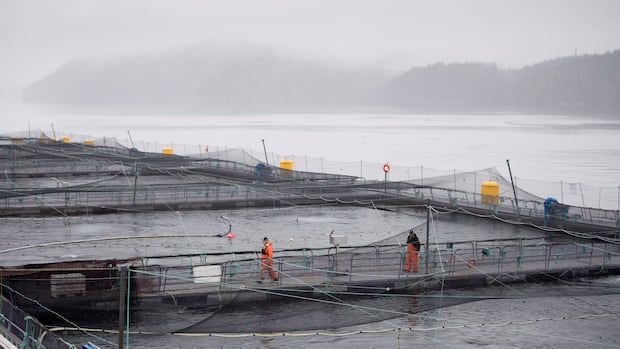

A recent peer-reviewed study by the Pacific Salmon Foundation, published in the journal Aquaculture, reveals that viral heart disease is more prevalent in open-net salmon farms in British Columbia than previously believed.
The research discovered heart and skeletal muscle inflammation (HSMI) in five out of seven open-net pen salmon farms located in the Broughton Archipelago, a series of islands situated east of Port McNeill on Vancouver Island.
Researchers also indicated that the virus responsible for the disease, piscine orthoreovirus (PRV), has the potential to disperse into nearby waters, posing a threat to wild fish populations.
Lead author Emiliano Di Cicco commented, “Our findings indicate that the prevalence of the disease is significantly higher than what was previously understood.”
The discussion surrounding open-net fish farms along the coast of B.C. has been ongoing, particularly concerning the risk of disease transmission from farmed fish to wild salmon migrating nearby.
In a previous study published in 2017, Di Cicco and his team identified the disease in one of four farms analyzed. However, Di Cicco noted that they suspected it was not an isolated incident.
“Now we possess evidence that contradicts that earlier belief,” he stated.
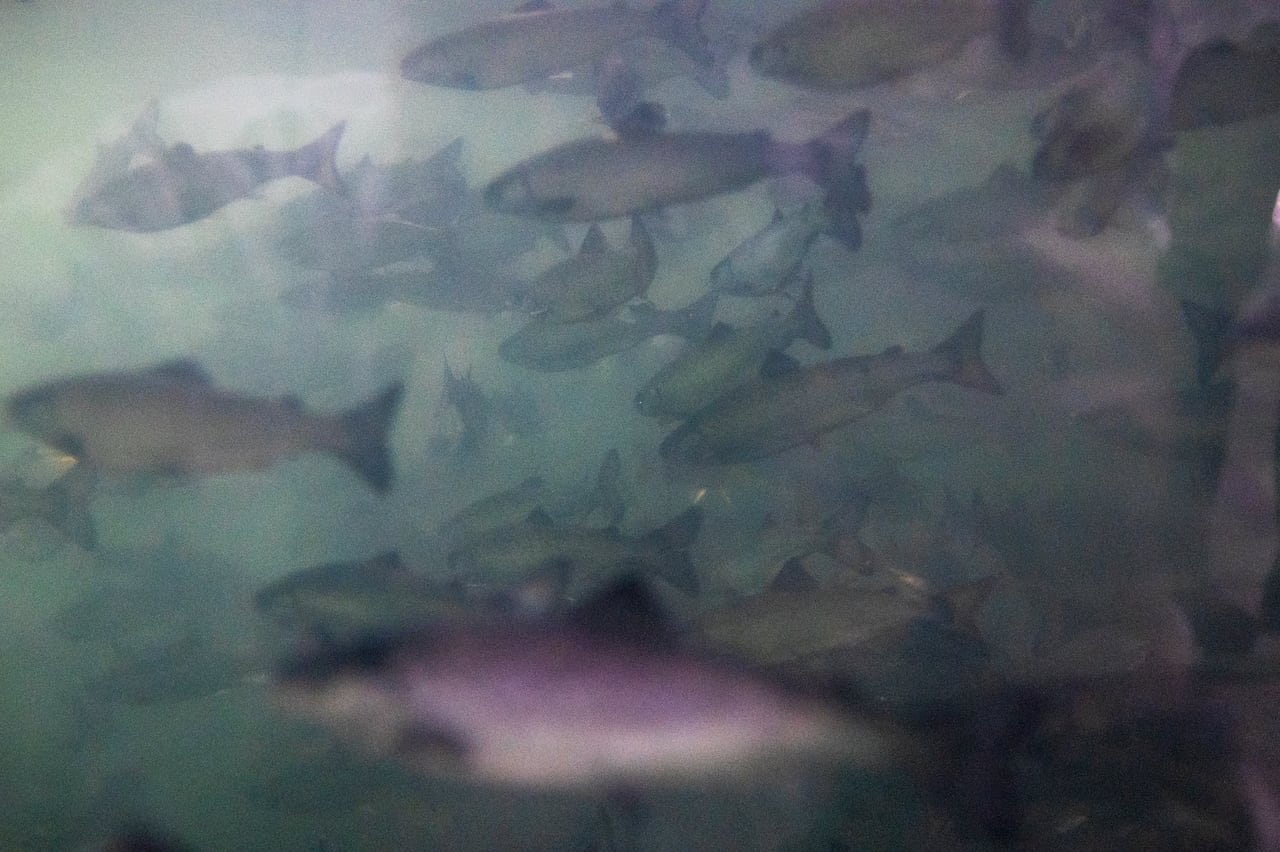
Hundreds of thousands of Atlantic salmon gather in a tank at Mowi’s Big Tree Creek salmon hatchery near Campbell River. (Kieran Oudshoorn/CBC)
DFO evaluating the findings
The study revealed that nearly seven percent of the 749 salmon examined by three independent pathologists showed indications of HSMI.
Ten years ago, the role of PRV in causing HSMI was still a matter of debate, partly because fish can carry the virus without showing any health issues. Nevertheless, experiments conducted by Norwegian researchers in 2017 established a clear link, according to Di Cicco.
The researchers noted that infected Pacific salmon might experience anemia, inflamed hearts, and damage to their livers and kidneys, as well as jaundice.
Despite this, Di Cicco pointed out that the Department of Fisheries and Oceans (DFO) in B.C. currently classifies the virus as non-pathogenic, meaning it is not considered disease-causing. He is urging the federal government to reconsider this classification.
Additionally, he advocates for diagnostic criteria for the disease to be consistent with those used in other nations. He expressed concerns that DFO’s standards for diagnosing HSMI rely on observable symptoms or significant mortality spikes within a population.
However, he emphasizes that globally, HSMI is recognized as a chronic, low-level condition.
“If you wait to diagnose the disease only when all these criteria are met, you are likely to overlook it,” Di Cicco said.
-
Federal Court of Appeal upholds decision to keep salmon farms out of B.C.’s Discovery Islands
-
New study shows increased pathogens near B.C. open-net salmon farms
In a statement, DFO indicated it would assess the study and its findings for future considerations.
“Identifying a virus or disease in farmed fish does not automatically indicate effects on or reductions in wild salmon populations,” the statement read.
DFO also noted that its diagnostic criteria for HSMI were developed in collaboration with leading scientific experts.
“In January 2020, veterinarians and pathologists from Canada and abroad established the current case definition of HSMI to ensure it meets rigorous scientific standards and aligns with the highest global benchmarks.”
The B.C. Salmon Farmers Association has not yet responded to a request for comment. The industry group has referred to concerns regarding PRV as “fearmongering,” asserting that the virus is “a common, relatively benign, and widely distributed marine virus.”
Industry representatives have asserted that salmon farming in B.C. provides numerous skilled jobs and accounts for 95 percent of Canada’s salmon output.
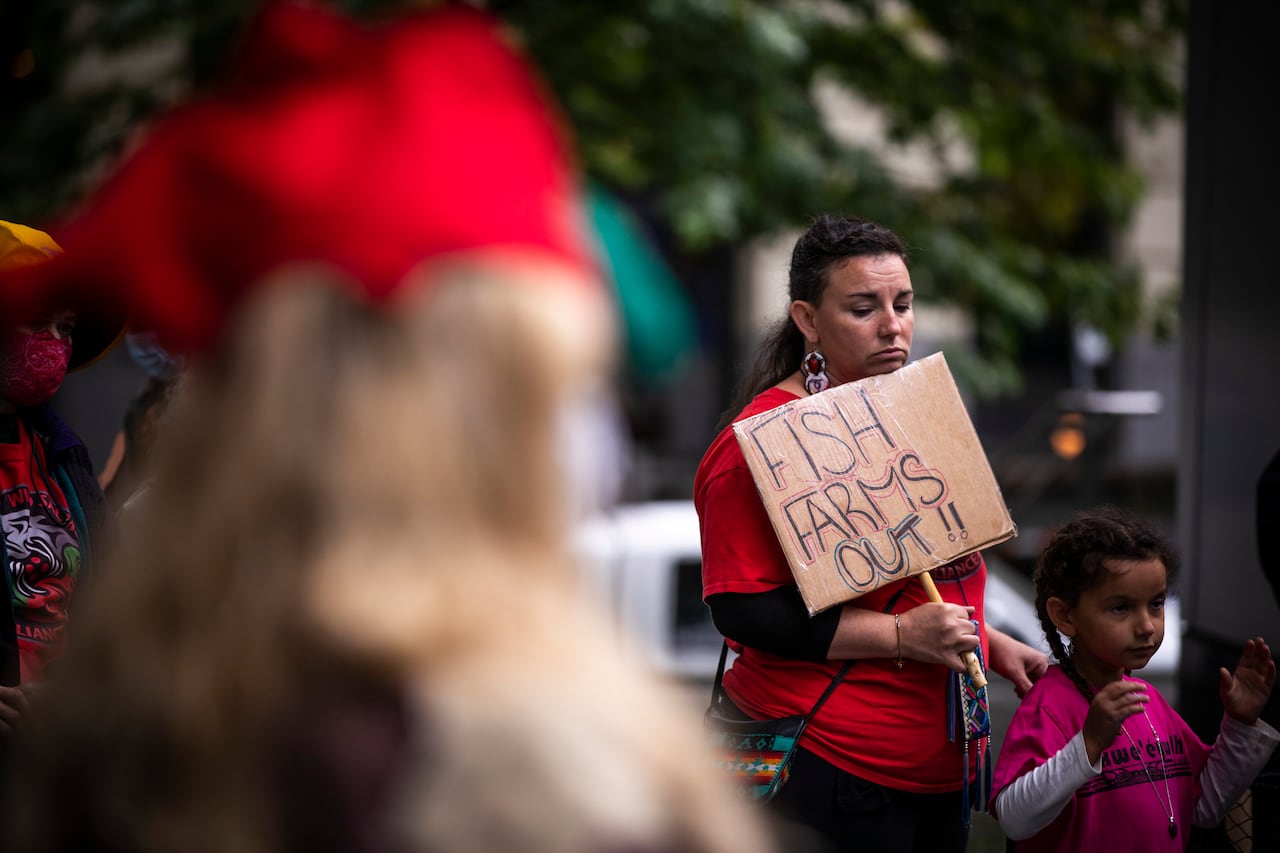
Protesters demonstrate in front of the Department of Fisheries and Oceans office advocating for an end to fish farms in B.C. in downtown Vancouver in September 2020. (Ben Nelms/CBC)
Collaboration with First Nations
This recent research was conducted in collaboration with the Mamalilikulla, ʼNa̱mǥis, and Ḵwiḵwa̱sut’inux̱w Ha̱xwa’mis First Nations.
Rick Johnson, Chief of the Kwikwasut’inuxw Haxwa’mis First Nation, stated that salmon have always been a crucial resource for the coastal Indigenous peoples of B.C., and now it is essential for people to support salmon.
“We always recognized there was an issue,” he remarked.
“It’s truly a blessing to have scientific validation for what we believed.”
Don Svanik, the elected chief councillor of the Namgis First Nation, expressed his long-standing fight for the closure of open-net pen salmon farms.
“We are salmon people… it’s an integral part of our identity,” he stated.
“Our ancestors understood its importance for the ecosystem and environment. I think humanity has somewhat neglected that.”