
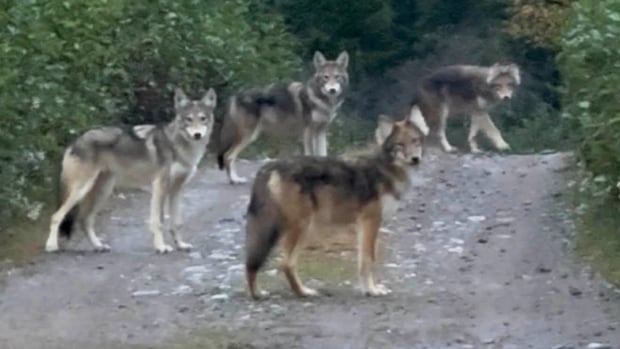

Wildlife officials in the province are pleased to receive reports about uncommon canids — specifically coyotes and wolves — as they work to monitor and gain a deeper understanding of these species’ presence on the island and in Labrador.
Interest in the possibility of wolves on the island resurfaced recently when Nikita Compton discovered and shared images online of a small group of animals near Goose Arm, located between Deer Lake and Corner Brook, igniting speculation among observers.
Could these animals be a hybrid of coyotes and dogs? Or perhaps a mix of coyote and wolf?
While officials acknowledged the challenges in identifying the animals without proper testing, they aim to enhance their understanding of the overall canid population.
Labrador wolves noted on the island
The Department of Forestry, Agriculture and Lands in Newfoundland and Labrador, which supervises the Wildlife Division, stated in an email Thursday evening that the Newfoundland wolf, believed to be separate from the Labrador wolf, is extinct since the 1930s.
Nonetheless, the email mentioned that Labrador gray wolves have been more recently observed on the island, with the first sightings recorded in 2008 and 2012.
-
Coyotes? Wolves? Who knows? Animal sighting near Deer Lake baffles online community
-
Canine conundrum: This N.L. biologist has ideas on what these animals could be
Since 2013, the Wildlife Division has been examining their movements. Biologists have collected genetic data from approximately 500 canid (wolf and coyote) carcasses found in the province. Among these, five animals displayed a genetic lineage that involved a mix of coyote and domestic dog, while four were confirmed as Labrador wolves.
Evidence of wolf DNA was detected in 28 samples.
Additionally, there are 427 more samples from deceased animals collected between 2023 and 2025, with results from genetic analysis pending.
Low wolf population on the island, says province
“Genetic findings indicate that wolves on the island have interbred with coyotes, but due to the significantly larger coyote population (in the thousands), the wolf genetics are likely diluted within the island’s canid population,” stated the staff.
The department’s staff highlighted the difficulty in determining a coyote’s genetic background solely by visual assessment. Coyotes naturally exhibit a variety of sizes, colors, and body proportions.
“Just because an individual coyote may not fit the typical appearance of the species, it does not imply that it is a recent hybrid with a wolf or dog,” they noted.
Nevertheless, the interest in this canid puzzle is welcomed and could contribute to ongoing research regarding wildlife in the province.
There are incentives for hunters and trappers who submit coyote and wolf carcasses, allowing provincial staff to gather information about the effects of coyote colonization on the island and what factors may facilitate wolf migration from Labrador to the island.
“We are also striving to increase the collection of canid samples from Labrador to enhance our ability to identify animals with wolf genetic heritage,” the response indicated.
In essence, this effort extends beyond the island. Hunters and trappers in Labrador are urged to reach out to the Wildlife Division regarding canid carcasses.
What to do if you see a coyote or wolf
Currently, provincial wildlife officials remind the public that coyotes and wolves are infrequently aggressive toward humans. However, it is advisable to avoid encouraging contact with these animals or feeding them.
If you come across a coyote or wolf, it is recommended to remain calm, refrain from running, and make noise, such as yelling or clapping, if the animal approaches. You can also wave your arms to seem larger. If the animal does not leave, you should continue making noise while gradually backing away.
Download our free CBC News app to receive push alerts for CBC Newfoundland and Labrador. Click here to visit our landing page.