
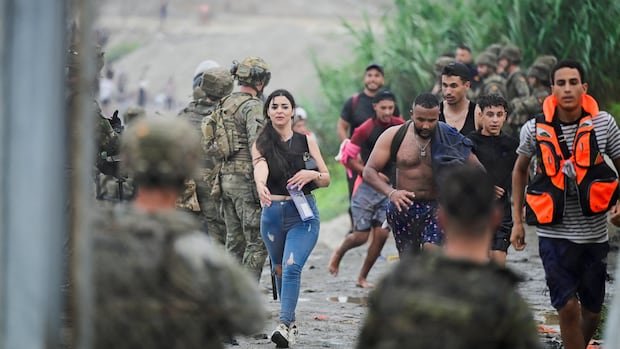

Spain and Morocco have strengthened the border fence of a Spanish enclave to curb the influx of migrants, significantly reducing mass crossings after a surge of around 60,000 people arriving by sea and land in a single day. Officials reported that at least 57 individuals have lost their lives in these recent events.
Following the mass influx into Ceuta, a small Spanish territory in North Africa, tensions escalated in Europe. France announced heightened border checks with Spain, while Italy even threatened to suspend Spain from the European Union’s open border agreement.
Moroccan authorities took action at the Ceuta border, using water cannon trucks, batons, and tear gas to prevent further crossings. The clashes resulted in damaged vehicles and a bus. Despite a court ruling imposing restrictions on immediate expulsions, Spanish authorities vowed swift removal of those who entered illegally.
Prime Minister Pedro Sanchez emphasized that the mass crossings violated Spain’s territorial sovereignty and urged Morocco to intensify efforts to control the migrant flow. Ceuta and Melilla, another Spanish city in North Africa, serve as the European Union’s sole land borders with Africa, experiencing periodic surges in migrant attempts to enter Europe.
Factors contributing to the recent surge in crossings may include a recent Spanish Supreme Court decision limiting the immediate return of migrants intercepted at sea. Migrants often swim from Moroccan towns like Fnideq to reach Ceuta or take shorter routes from towns like Belyounech.
In response to the situation, European nations are bolstering border security measures. France announced a fivefold increase in police presence at the Spanish border, coupled with aerial surveillance and train patrols. Italy’s Prime Minister expressed readiness to adopt extraordinary measures, including suspending the Schengen Area agreement with Spain, to safeguard borders and citizens.
Migration remains a contentious issue in Europe, especially for right-wing parties. Leaders like German Chancellor Friedrich Merz and Finland’s interior minister supported stricter border controls. Meanwhile, U.S. President Donald Trump likened the Ceuta crossings to an invasion, warning of similar scenarios in the United States without stricter immigration policies.
While Spain’s government emphasizes its stance on illegal crossings, it also recognizes the economic contributions of immigrants. The government has implemented a mass amnesty program, granting hundreds of thousands of individuals the opportunity to seek Spanish citizenship, a move that has faced criticism from some European counterparts.
The diplomatic tensions between Spain and Italy escalated, with Italy’s Foreign Minister criticizing Spain’s citizenship grants, prompting a rebuke from Spain’s Foreign Minister, who called for solidarity over partisan rhetoric in handling the immigration crisis.