
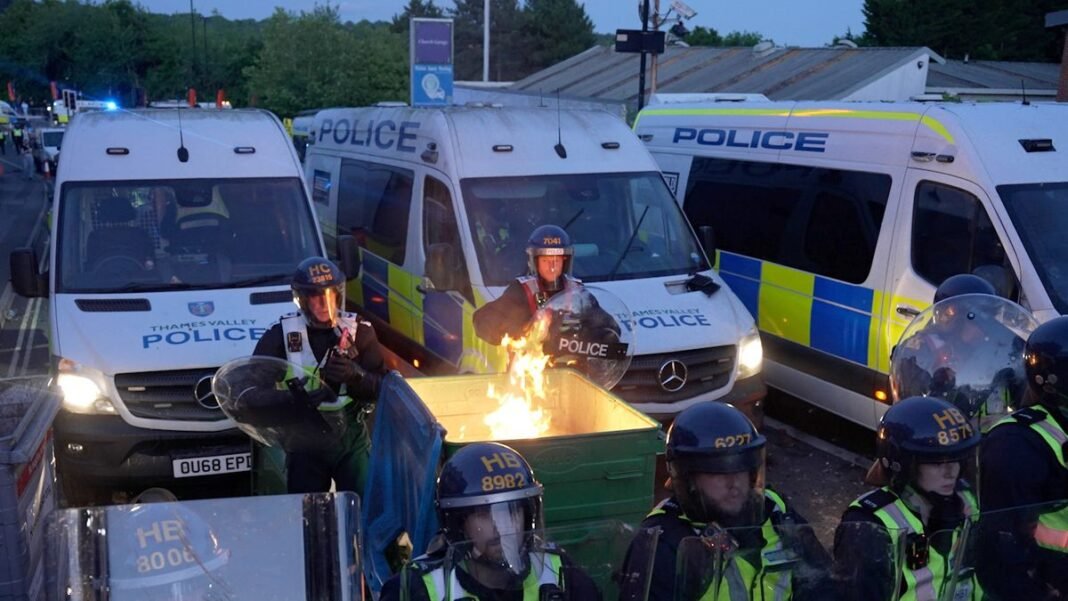

Social media has been described as a potential powder keg following recent events like the Henry Nowak case, according to experts. A series of violent clashes between demonstrators and law enforcement unfolded in Southampton this week following the tragic death of the 18-year-old student, reminiscent of the 2024 Southport unrest.
Criticism has been directed at Nigel Farage for his call for “pure cold rage” and accusations of “two-tier policing” in response to the incident, with Keir Starmer accusing him of exploiting the situation without condemning the resulting violence.
Experts in the digital and political realms are urging social media platforms to take more decisive action to prevent the rapid dissemination of contentious or harmful content on their services to prevent it from inciting real-world unrest.
Dr. Carolina Are, a digital criminologist at LSE, pointed out that right-wing politicians like Farage leverage social media algorithms by creating succinct, attention-grabbing clips that can quickly go viral, leading to the rapid spread of their messages.
According to Manuel Tonneau, a social data science researcher at the Oxford Internet Institute, platforms such as Elon Musk’s X tend to create echo chambers where users are surrounded by like-minded individuals, potentially encouraging them to translate their online anger into physical actions.
Tonneau highlighted the role of less moderated platforms like Telegram in facilitating offline violence through the organization of protests. He emphasized that social media’s business models often incentivize engagement with controversial content, exacerbating existing tensions.
Imran Ahmed, CEO of the Center for Countering Digital Hate, warned that social media platforms are fostering a cycle that amplifies conspiracy theories and divisive content, leading to real-world consequences by fueling racial animosity and spreading misinformation.
Ofcom, the media regulator, is under scrutiny for its response to online harms following the Nowak case, with calls for stricter enforcement of the UK’s online safety laws to hold tech companies accountable for content on their platforms.
Failure to comply with UK regulations could result in significant fines or service restrictions for tech firms. Under the Online Safety Act, misinformation must be promptly removed if it is deemed illegal or harmful, with investigations already initiated into numerous sites and apps for non-compliance.
The incident surrounding Henry Nowak’s murder has sparked public outrage and raised concerns about the role of social media in exacerbating societal tensions and spreading misinformation.