
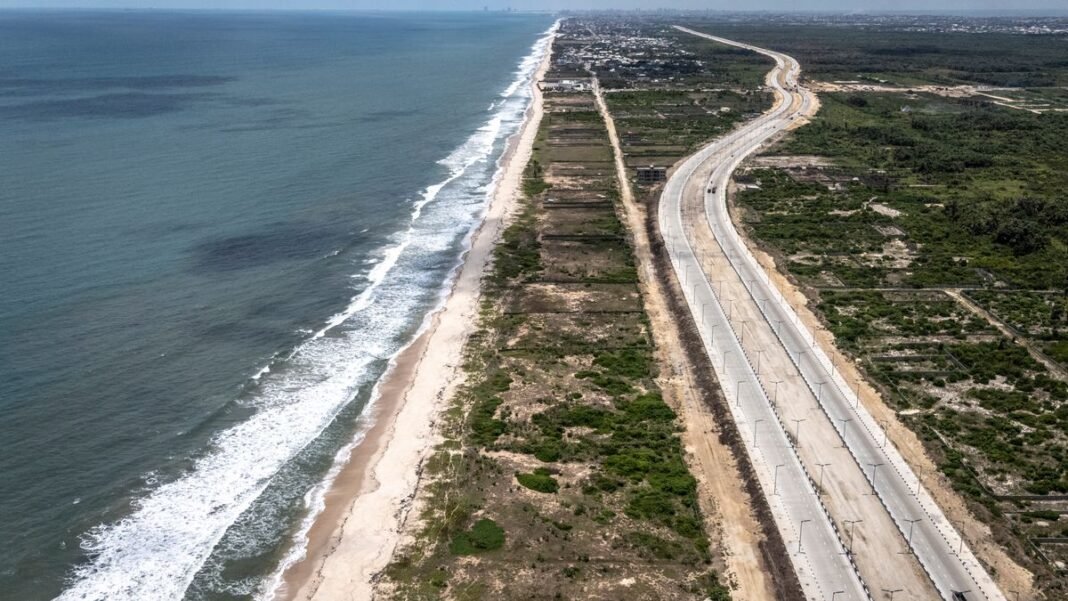

A sprawling coastal roadway is under construction along the Atlantic shore, despite significant apprehensions. The 430-mile highway, connecting Nigeria’s bustling capital Lagos with Calabar near the Cameroon border, is being developed at an estimated cost of around £8.5 billion.
The ambitious highway initiative is championed by Nigerian president Bola Tinubu, who aims to overhaul the country’s transportation infrastructure and promote tourism. During a ceremony marking the inauguration of the first segment of the highway, Tinubu stated, “We are creating a road that will stand the test of time.”
However, environmentalists have voiced serious concerns, noting that the highway could face heightened risks from projected sea level increases in the upcoming years. Nnimmo Bassey, an environmental advocate and former head of Friends of the Earth International, criticized the Lagos-Calabar Coastal Highway as a symbol of climate inaction.
Highlighting the vulnerability of Nigeria to rising sea levels, the fishing hub of Aiyetoro in Ondo State suffered significant losses due to an ocean surge in 2024, resulting in the disappearance of 80% of its land area and a significant population decline.
Despite the environmental warnings, President Tinubu remains resolute in pushing forward with the project, positioning it as a pivotal element of his re-election campaign. The long-awaited road, pending for nearly five decades, is seen by Tinubu and his backers as crucial for Nigeria’s economic advancement.
Orji Uchenna Orji, an advisor to Nigeria’s public works minister, emphasized the transformative impact of the Lagos-Calabar Coastal Highway on the nation’s political and economic landscape, projecting it to become a key economic corridor in Africa.
The government is anticipated to contribute 30% of the $12 billion budget for the highway, with Hitech Construction Company Ltd. covering the remaining costs. Hitech plans to recover its investment through toll collection on the highway over a 15-year period.
In addition to its involvement in the coastal highway project, Hitech is also behind the Eko Atlantic development – a privately funded futuristic city near Lagos safeguarded by a substantial concrete barrier. Similar protective measures, including sea walls and natural barriers, are planned for the highway to mitigate environmental impacts.
The construction of the super-highway has raised concerns about exacerbating environmental degradation in Nigeria, given the country’s history of significant natural habitat loss due to extractive industries. The route through Stubbs Creek Forest in Akwa Ibom state, a protected area home to endangered species, has particularly drawn attention for potential ecological disruption.
Research indicates a concerning trend of coastal erosion in Lagos State, with a significant portion of coastline receding over the years. Despite environmental assessments suggesting limited impact from sea level rise on the Lagos section of the highway, projections of global temperature increases raise uncertainties about the project’s long-term sustainability.
While the project faces environmental challenges and criticisms, the government and contractors are determined to forge ahead with the ambitious infrastructure development, aiming to propel Nigeria’s economic growth and connectivity.