
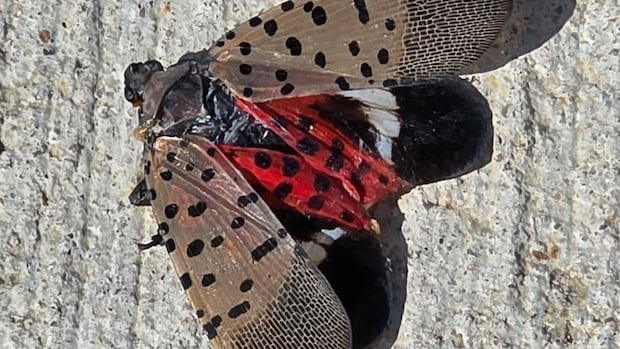

An exotic insect notorious for destroying grapevines and affecting various crops and trees has been identified in Canada for the first time by the Canadian Food Inspection Agency (CFIA). The initial detection occurred in Windsor.
Reports from Windsor residents of previous sightings of the spotted lanternfly have been documented by a non-profit organization dedicated to preventing the spread of invasive species. However, this marks the first time the insect has been officially identified through an agency survey, as stated by the Invasive Species Centre.
According to the Invasive Species Centre, the spotted lanternfly is capable of causing significant harm to grapevines, creating substantial repercussions for the grape and wine industry. Additionally, the pest poses a threat to other agricultural producers, as well as the horticulture and forestry sectors, along with residential areas and neighborhood parks. Uncontrolled spread of the spotted lanternfly could lead to widespread economic, environmental, and social consequences.
Originally native to southeast Asia, the spotted lanternfly was first discovered in North America in Pennsylvania in 2014. This insect feeds on the sap of more than 100 different plant species.
The Invasive Species Centre urges people to familiarize themselves with the appearance of the insect. If individuals encounter a spotted lanternfly or its eggs, they are advised to take photographs, place the insect or eggs in a sealed plastic bag or container, and report the finding to the CFIA promptly. The release emphasizes the importance of all Canadians reporting any suspected sightings of the spotted lanternfly to the CFIA, providing accurate location details and images for effective response and management.
To aid in identifying the spotted lanternfly, the Invasive Species Centre and CFIA offer several tips:
Adults:
– Approximately 25 mm in length and 12 mm in width.
– Light brown/grey front wings with black spots and dark speckled bands near the back.
– Red rear wings with black spots near the front and white and black bands at the back.
– Yellow abdomen with horizontal black stripes.
– Often found in large groups on trees, grapevines, and other plants.
– Most active during September and October, particularly during mating and egg-laying periods.
Nymphs:
– Early-stage nymphs are black with white spots.
– Late-stage nymphs are red with black and white spots.
– Typically visible in spring and summer.
– Tend to cluster in swarms and ascend plants and trees to feed.
Eggs:
– Egg masses appear as grey mud smears on host trees and outdoor surfaces.
– Older egg masses lose their grey coating and resemble seeds arranged in vertical rows.
– Egg masses are around 25 mm long.
– Usually visible from September through winter, hatching in spring.
The spotted lanternfly excretes a sticky, transparent liquid called honeydew, which can accumulate at the base of host trees and encourage the growth of sooty mold. This secretion may attract bees and wasps.
To minimize the spread of the spotted lanternfly, the Invasive Species Centre recommends the following measures:
– Check vehicles and outdoor items for egg masses, nymphs, or adults when visiting areas with known infestations.
– Consider utilizing a high-pressure car wash for cleaning your vehicle.
– Refrain from transporting firewood; opt to purchase and burn firewood sourced locally.