
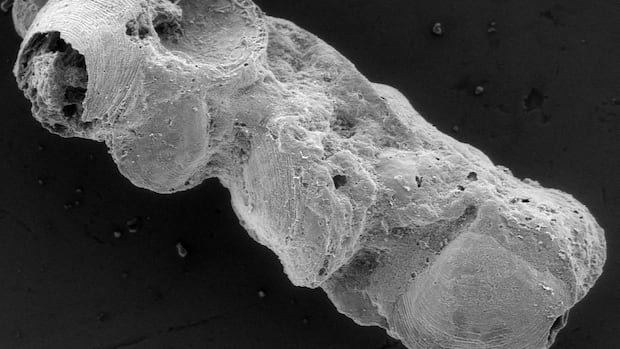

Long before dinosaurs existed, a surge in biodiversity led to the appearance of early forms of modern animals and an increase in fecal matter. A recent study sheds light on the significance of analyzing coprolites, or fossilized feces, in comprehending Earth’s ancient ecosystems, nutrient cycles, and animal interactions.
The research, published in the journal Trends in Evolution & Ecology, delved into fecal fossils from the Cambrian period, dating back around 540 million years. By examining feces remnants from primitive worms, invertebrates, and mollusk-like organisms, scientists uncovered that fecal matter played a crucial role in enhancing the habitability of deep-water ecosystems and increasing nutrient availability during that era, long before the age of dinosaurs.
The study’s revelation that feces were abundant during the Cambrian period holds key implications for understanding the origins of present-day ocean ecosystems. Julien Kimmig, co-author of the study and head of the paleontology division at the Karlsruhe Natural History Museum in Germany, emphasized the importance of recognizing the substantial role feces played in sustaining both ancient and contemporary marine ecosystems.
By scrutinizing coprolites, which are fossilized and mineralized fecal remains found in rocks, Kimmig and Russell Bicknell examined hundreds of fecal samples from various deposits worldwide. These coprolites originated from burrowing worms, arthropods, brachiopods, and hyoliths, with sizes ranging from microscopic in the early Cambrian to as large as a rabbit dropping by later stages. The analysis not only offers insights into evolutionary patterns and predator-prey relationships but also aids in unraveling Earth’s ecological dynamics during the Cambrian Explosion.
Kimmig highlighted the significance of ecology in paleontology, emphasizing how understanding past ecosystems’ responses to environmental changes can provide valuable lessons for future scenarios. By studying coprolites, researchers can unravel the intricate connections between organisms, their habitats, and the evolutionary adaptations that have shaped ecosystems over time.
The study further underscored the pivotal role of feces in the Cambrian Radiation, signaling a notable increase in fecal traces compared to the preceding Ediacaran period. By delving into coprolites, researchers can gain a deeper understanding of nutrient and energy cycles, shedding light on the broader ecological implications and the potential for modeling future ecosystems based on ancient records.
For paleontologists, feces have emerged as a crucial avenue of research, offering unique insights into ancient ecosystems and interactions among different species. Karen Chin, a renowned paleontologist and curator at the Museum of Natural History, emphasized the importance of studying coprolites to unravel complex food webs, nutrient cycles, and biological interactions from prehistoric times.
Chin’s research on coprolites from the Mesozoic era, when dinosaurs roamed the Earth, highlights how fecal fossils provide vital clues about ancient diets, ecological relationships, and carbon cycling processes. Despite the challenges of studying coprolites, Chin emphasized their untapped potential for uncovering hidden facets of ancient ecosystems and enhancing our understanding of evolutionary processes.
The study’s findings underscore the need to accord coprolites the attention they deserve, as these often-overlooked fossils hold the key to unlocking a wealth of information about Earth’s ancient past and its relevance to shaping modern and future ecosystems.
In conclusion, the study’s exploration of coprolites from the Cambrian period offers a unique perspective on Earth’s evolutionary history and the intricate interplay between organisms, environments, and ecological processes across geological time scales.