
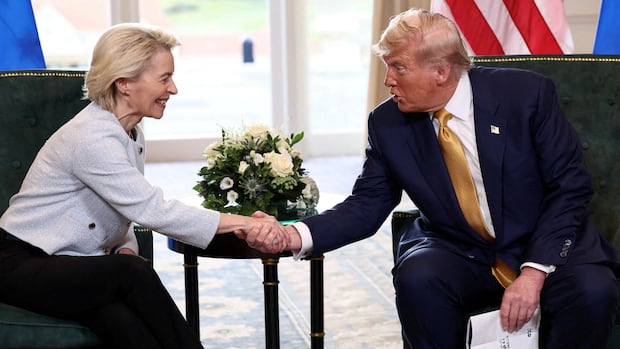

During a meeting last year at Donald Trump’s Turnberry golf resort in Scotland, Ursula von der Leyen, the leader of the European Union, assured Europeans that agreeing to a 15 percent U.S. tariff on EU exports would provide the continent with “predictability and stability.”
However, some critics now perceive the trade agreement as an uneven concession that has instead opened the door to a continuous cycle of economic pressure from the United States.
Initially, the U.S. sought to reclassify specific European industrial products to impose elevated tariffs. Now, a new conflict has arisen concerning Europe’s efforts to introduce a digital services tax aimed at U.S. tech giants—this dispute mirrors Washington’s recent attempts to dictate tax regulations to Canada.
Almost immediately after the European Parliament ratified the Turnberry agreement, Trump took to Truth Social, threatening to nullify the entire deal by enforcing 100 percent tariffs on any European country that imposes or expands tech taxes.
As European opposition to Trump’s demands grows stronger, some lawmakers are viewing Mark Carney’s dramatic departure from U.S. trade negotiations not as a reckless risk but as an example of how to confront a bully.
Gerard Araud, a former French ambassador to the U.S., stated that “Canada should lead by example for the EU: with Trump, only firmness yields results.”
“Nations committed to democracy and the rule of law—and unwilling to accept the law of the jungle—must unite,” remarked Bernd Lange, a German parliamentarian and chair of the EU’s trade committee, on X. “We stand with Canada.”
From former Swedish Prime Minister Carl Bildt:
“With Canada, China, and Brazil demonstrating that it is possible to confront the United States in trade discussions, it seems there will be a discreet conversation within the EU and Japan regarding whether they made the right decision.”
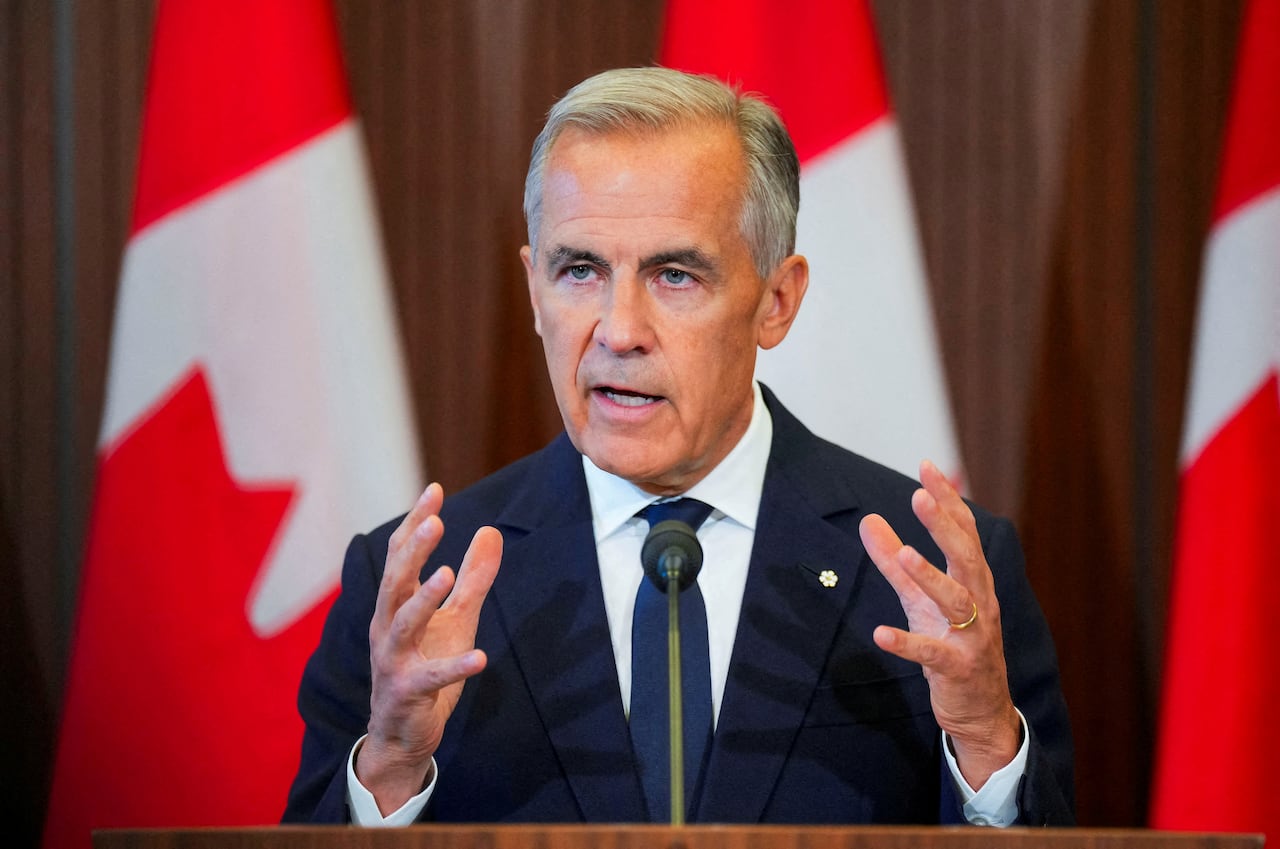
Carney’s approach to handling U.S. President Donald Trump is quietly admired in Europe. (Chris Tanouye/Reuters)
Subtle support
Currently, “discreet” seems to be the key term.
Very few, if any, of Europe’s leaders have openly rushed to defend Carney in the trade conflict, likely perceiving no clear need to provoke Trump’s anger.
Yet observers suggest that behind closed doors, Canada’s strategy is viewed with respect.
“The fact that Canada walked away is an intriguing and positive example for Europeans, indicating that you don’t have to accept everything,” stated Tobias Gehrke, a senior policy fellow with the European Council of Foreign Relations.
“It might be necessary to walk away and apply pressure on Washington to achieve a better agreement.”

People gather to protest on the day of the opening of a new U.S. consulate in Nuuk, Greenland, on May 21, 2026. (Tim Barsoe/Reuters)
Thus far, Europe has only been inclined to draw clear red lines with Trump regarding territory rather than trade.
Trump’s dramatic attempts to pressure Denmark into relinquishing the semi-autonomous territory of Greenland led to widespread condemnation across the EU, U.S. diplomatic isolation, and even a modest military response from Denmark and Europe.
It was only after his threats to annex the territory jeopardized the NATO military alliance that Trump retreated, at least partially, shifting his focus to a somewhat ambiguous future framework for resource development in Greenland as a compromise.
Gehrke emphasizes that while Greenland’s territorial integrity was at stake, disputes over trade do not evoke the same widespread European fervor.
“On straightforward trade matters, whether the tariff is set at 15 percent, 13 percent, or 17 percent, there has been considerably less interest from Europeans to escalate or truly push back,” Gehrke remarked.
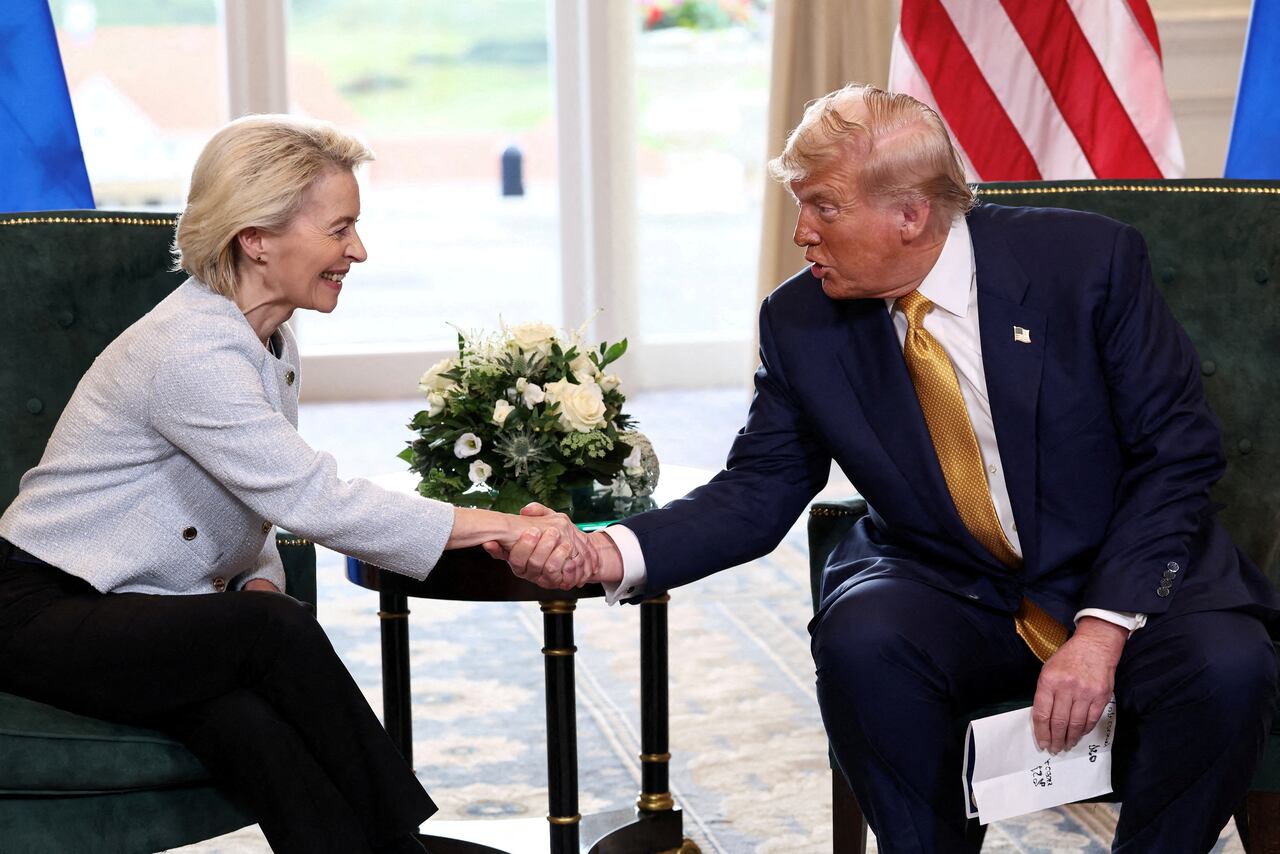
U.S. President Donald Trump shakes hands with European Commission President Ursula von der Leyen following the announcement of a trade agreement between the U.S. and EU in Turnberry, Scotland, on July 27, 2025. (Evelyn Hockstein/Reuters)
Lukewarm trade agreement
Britain’s pursuit of trade stability with Trump has certainly yielded much less than anticipated.
Former Labour Prime Minister Keir Starmer was among the first leaders to rush to secure a trade deal at the beginning of Trump’s second term.
Like Europe, many in Britain now perceive that deal as having quickly lost its appeal. British exporters faced a standard 10 percent tariff on most goods shipped to the U.S., with even heavier penalties on steel and aluminum.
However, the real blow came when Trump promptly extended similar trade agreements to global competitors like Japan and South Korea, rapidly diminishing the U.K.’s competitive advantage.
When Washington threatened 100 percent tariffs in response to Britain’s existing digital services tax, it left Downing Street extremely anxious. Instead of matching Trump’s hostility, British officials set the stage for a retreat earlier this summer, indicating publicly that the domestic tech tax might be “reconsidered.”
Carney pointed out this very pattern of behavior after the collapse of Ottawa’s negotiations, explicitly warning that a U.S. agreement under the current administration is often “written in pencil.”

An Apple store in Paris. The Trump administration and European governments have been at odds over taxing U.S. tech giants. (Abdul Saboor/Reuters)
Sophisticated audience
However, trade specialists caution that a significant hurdle prevents Europe—or the U.K.—from easily duplicating the Canadian model: the sophistication of the Canadian public regarding trade and the harsh reality of economic resilience.
“In Canada, there exists a unique situation where the population is very much in favor of defending what they perceive to be Canada’s interests,” explained Arun Venkataraman, a lawyer at Covington and Burling who previously worked as a U.S. Commerce Department official in the Biden administration and was a negotiator in the Office of the U.S. Trade Representative during the Obama Administration.
Venkataraman highlights that Canadians deeply understand the extensive integration of their economy with the U.S., leading to a collective willingness to endure the repercussions of a failed negotiation, which is quite rare.
“For the Canadian public to be where it is today, strongly supporting the prime minister’s position, is not something that can be easily replicated in other nations,” Venkataraman remarked to CBC News.
European Union flags flutter outside the European Commission headquarters in Brussels, Belgium, on Feb. 26, 2026. (Yves Herman/Reuters)
Yet he cautions that the public, dramatic nature of Carney’s “no” is merely the initial chapter of a much longer, more difficult confrontation.
“It is one thing to be intellectually prepared to endure the consequences that are anticipated from a failed negotiation with the Trump administration,” Venkataraman explained to CBC News.
“It is an entirely different matter to experience that pain over time. The duration of these conflicts significantly affects and tends to diminish the political will that may have existed at the outset.”
Volatile shift
The waning political will is precisely why European allies are currently choosing to lay low while the heated rhetoric unfolds.
“Your readiness to compromise and accept specific agreements at the negotiating table is influenced by your perception of the long-term relationship,” Venkataraman stated, adding that the unpredictable shifts in Washington’s reliability “ultimately harm the United States.”
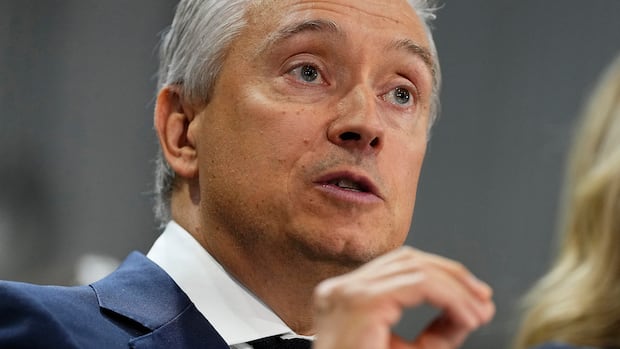
The federal government outlined Canada’s strategy to retaliate against the U.S., announcing billions in counter-tariffs on various American products including fish, cosmetics, and furniture.
This declining trust extends well beyond Ottawa, Brussels, or London.
A survey conducted in June 2026 by the Pew Research Center revealed that only 23 percent of adults globally expressed confidence in Trump’s leadership.
The report highlighted that this downturn has occurred “in several countries with which the U.S. has longstanding economic and security partnerships,” noting that the drop in reliability ratings was most pronounced among America’s closest traditional allies, including Germany and Canada.
Despite the challenges faced by Europe, the U.K., and Canada, Venkataraman reminds us that final agreements—or disagreements—are seldom truly final.
“The history of trade negotiations is filled with instances of failed discussions that were later revived,” he stated.
“Never say never—we understand that it often takes a series of failures, even dramatic ones, to reach the right conclusion.”Â