
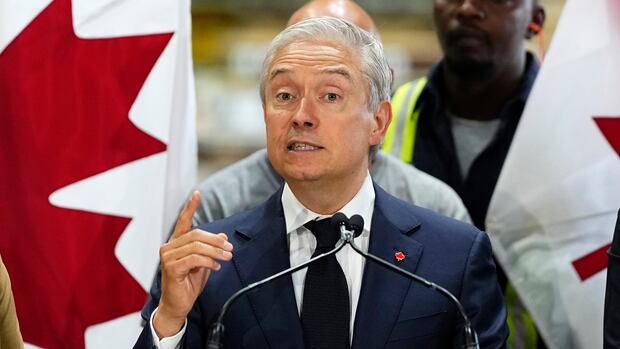

In the wake of stalled trade discussions with the Trump administration, the Liberal government is unveiling a $7.5 billion initiative aimed at assisting workers and businesses cope with the newly imposed 50 percent tariffs on $27.6 billion worth of Canadian goods by the U.S. president.
On Tuesday, Finance Minister François-Philippe Champagne, along with other cabinet members, announced that beginning September 8, the Canadian government will impose tariffs equaling the U.S. duties dollar for dollar on $27.6 billion in similar American products.
“This represents an extraordinary challenge for Canada, but we are ready to rise to it. Canadians, together, will face this moment,” Champagne stated during the announcement at a roofing business in Ottawa.
“We are committed to supporting our workers, businesses, and industries with all necessary resources, for as long as is required.”
Officials providing background information earlier indicated that this support package is in addition to the nearly $25 billion in tariff support that has been implemented over the last 18 months.
The new measures are specifically tailored to assist workers and businesses, focusing primarily on small- and medium-sized enterprises throughout the nation, according to officials.
Support for Workers and Small Businesses
Included in the support initiative, the Liberal government is allocating $3.5 billion from the $7.5 billion to establish a rapid response program for employees and employers.
Some of these funds will be used to extend three enhancements to Employment Insurance (EI) initially announced in September 2025, which were set to lapse on October 10, including:
- Extending the waiver of the one-week waiting period for EI benefits for an additional year.
- Allowing workers to receive EI payments without first depleting their separation payments until October 10, 2027.
- Providing long-tenured employees with an additional 20 weeks of EI until June 2027.
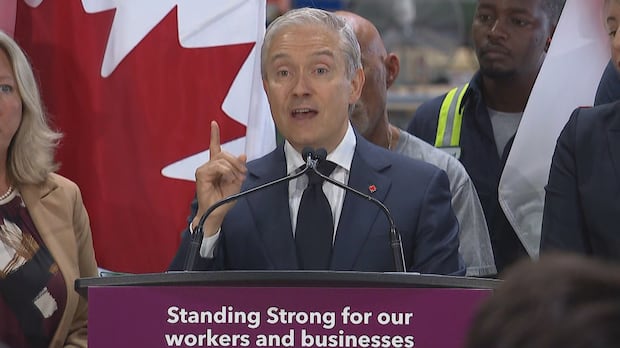
Finance Minister François-Philippe Champagne states that Canada will implement tariffs in a ‘proportionate, targeted, and strategic’ manner to match the latest U.S. tariffs affecting over $27 billion in American goods.
Two new initiatives will allow workers who voluntarily leave their jobs to claim EI without penalties, and to assist in connecting unemployed or underemployed individuals with significant projects in need of labor.
Employers are eligible for up to $1,000 per employee to offset costs related to training and administering EI work-sharing and retention programs.
This enables employers to reduce an employee’s work week from five days to two, while allowing the employee to receive EI for the remaining three days at 70 percent of their income, compared to the standard rate of 55 percent.
“Retaining skilled workers during downturns helps businesses maintain talent and supports employees through challenging periods,” remarked Minister of Jobs and Families Patty Hajdu.
Financing and Loans
Additionally, the government is investing $2 billion to establish the Canada Strong Diversification Fund, aimed at “supporting companies affected by tariffs with shovel-ready projects that sustain ongoing capital maintenance, including medium-sized firms.”
Larger companies will benefit from increased flexibility due to adjustments made to the government’s Large Enterprise Tariff Loan facility (LETL).
-
What we know about how the Canada-U.S. trade talks fell apart
-
Trump says idea of him interfering with Canadians speaking French is a ‘stupid thing’
Introduced in March 2025, the LETL offers eligible companies 24 months of financial liquidity. With the support plan announced on Tuesday, this period will be extended to 36 months, and the maximum repayment term for loans will increase from 10 years to 15.
Medium-sized businesses across the country will have access to an additional $1.5 billion in funding through one of Canada’s seven regional development agencies.
This additional funding raises the cap on non-repayable grants to $3 million from $1 million. Furthermore, interest-free loans up to $2 million will also be offered to qualifying enterprises.
Industry Minister Mélanie Joly stated that these programs will be accessible to businesses earning over $1 million in revenue.

At Issue special edition: Canada-U.S. trade talks collapse and President Donald Trump threatens even more tariffs. Was it the right decision for Prime Minister Mark Carney’s government to walk away and is a deal still possible?
The Business Development Bank of Canada will introduce a second $500 million liquidity stream to offer working capital assistance for small- and medium-sized businesses facing cash flow challenges.
Companies affected by the tariffs will be eligible for loans ranging from $250,000 to $5 million, with the option to make interest-only payments for 36 months, extending beyond the conclusion of Trump’s second term.
Canada’s New Retaliatory Tariff System
The retaliatory tariffs will focus on the same products that the Trump administration targeted when imposing Section 338 and 232 tariffs on Canada. A comprehensive list of over 700 products being affected is available online.
U.S. President Donald Trump’s Section 232 tariffs, ranging from 10 to 50 percent, were applied to steel, aluminum, copper, automobiles, lumber, their derivatives, and certain semiconductors.
The 338 tariffs cover a variety of Canadian products, from hockey sticks to alcohol and dairy, and took effect on Saturday following the breakdown of trade negotiations between the two nations.
Officials noted that Canada’s tariff strategy is aimed at safeguarding domestic industries rather than generating revenue. To achieve this, Canada’s tariff rates on specific products will correspond to the U.S. tariffs on those same goods.
Ministers indicated that they have strategically chosen U.S. products for which Canadian alternatives exist.
Earlier on Tuesday, Prime Minister Mark Carney spoke with federal opposition leaders to brief them on his administration’s response to Trump’s recent tariff escalation.
“The prime minister and the leaders discussed the ongoing response and highlighted the necessity of a unified Team Canada approach as Canada aims to protect jobs, foster economic growth, and advocate for Canadian interests,” stated a release from the Prime Minister’s Office.
NDP Leader Avi Lewis conveyed to CBC’s Power & Politics his clear support for “walking away” from negotiations with Carney. Lewis emphasized the need for additional measures such as export taxes on oil and gas to apply pressure on the U.S.
“We are confronting a relentless adversary across the negotiating table, and New Democrats want to see the government assert Canada’s power,” Lewis stated.
Following the meeting, Conservative Leader Pierre Poilievre released a statement urging Carney to disclose the text of the rejected agreement, recall Parliament, and “implement an emergency economic action plan to protect jobs and reduce expenses for Canadians.”
This initiative would entail the government eliminating all gas taxes until the next Canada Day, exempting those who reinvest in Canada from capital gains taxes, and other proposals the Conservatives included in their previous federal election campaign.
Joly rebuffed Poilievre’s requests, asserting that the Conservative leader has consistently opposed Liberal measures aimed at aiding workers and businesses.
“I would advise Mr. Poilievre to practice what he preaches,” Joly remarked.