
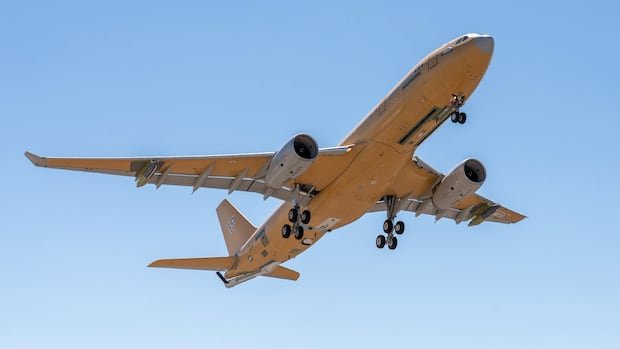

Canada’s air force will not receive the first of four new air tankers crucial for refuelling fighter jets in the Arctic until the end of next year. The Royal Canadian Air Force (RCAF) has provided details for the first time on the status of the CC-330 Husky fleet acquired to replace its aging Airbus 310s. These wide-body jets are essential for the air force’s intercontinental operations, including troop transportation and global travel for the prime minister. However, their primary importance lies in serving as airborne refuelling stations to enhance Canada’s continental defense.
According to a Department of National Defence spokesperson, the initial new aircraft will be handed over to the RCAF in late 2027. In July 2023, Canada procured nine Airbus A330s for around $3.6 billion, comprising five pre-owned jets with minimal service history from Kuwait Airways and four brand-new aircraft. The department had not previously revealed how many of the new planes would be delivered by the upcoming year.
Presently, three of the pre-owned Airbus planes have arrived in their original passenger configuration. They are currently in use for passenger transport, including the prime minister, with one undergoing scheduled maintenance at Mirabel Airport. The fourth aircraft is undergoing interior and defence upgrades in Switzerland, while the fifth is being converted into an air tanker in Spain. The first new air tanker is undergoing testing in Spain, and the remaining three new builds are in production in Toulouse, France.
The RCAF’s CF-18 fleet, soon to be joined by new F-35s, requires air tankers to maintain patrols over the Arctic. Fighter jets consume fuel rapidly and rely on air tankers to extend their operational range and time aloft. This need was highlighted during the FIFA World Cup events in Toronto this past summer when an aging air tanker supported CF-18s to remain airborne over the stadium for extended periods. The upcoming tankers will possess the necessary boom and hoses to refuel all NATO-compatible aircraft, unlike the aircraft they are replacing, which lacked the required equipment for certain aircraft models.
Recent discussions about threats to world leaders’ aircraft have prompted the air force to equip the new V-VIP Airbus, currently being renovated in Switzerland for the prime minister, with a “self-protection suite” to defend against missile attacks. This system may include lasers, flares, and aluminum foil to counter incoming threats. While most components will not be visible externally, discernible bulges on the aircraft’s skin will provide clues about the system’s capabilities, which may attract attention from plane spotters and foreign entities.
The air force anticipates that the initial operational capability for the CC-330 Husky fleet will be achieved by 2028-29, with full operational capability for all nine aircraft expected by 2032-33. The current aircraft are stationed in Ottawa, but new facilities are under construction in Trenton, Ontario, and Edmonton.
The RCAF’s existing fleet of five Airbus A310s, also known as the CC-150 Polaris, originally served as Wardair passenger planes in the late 1980s. While one of the former aircraft is now a museum piece in Trenton, another was declared irreparable following a parking incident in Guam in 2023. The remaining three A310s are scheduled to remain in service until 2030.