
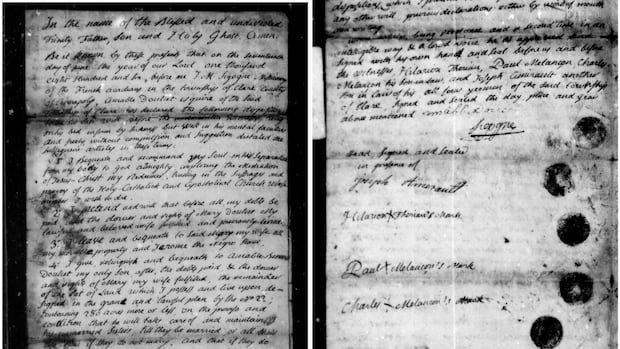

In the 19th century, Hilarion Thériault, aged 71, broke the norm by creating a will, an unusual practice among Acadians back then due to their limited property ownership post the Acadian deportation. Thériault, unwilling to face death unprepared, specified in his will the settlement of debts and the seeking of reparations for any misconduct, aiming to bring peace to his family.
Colby Gaudet, a post-doctoral researcher at Dalhousie University, delved into Thériault’s will and 23 others from Clare, N.S., to explore how these families navigated legal and religious customs surrounding death. Gaudet noted that while Acadians adopted Anglophone legal frameworks, they also emphasized their Roman Catholic identity in their wills, blending resistance with adherence.
Maurice Basque, a historian at l’Institut d’études acadiennes at the Université de Moncton, highlighted the social ostracism faced by Acadians during that era, shaped by the forced deportation in 1755 by Lt.-Gov. Charles Lawrence. The Crown seized Acadian lands, redistributing them to settlers from New England to diminish the Acadian population over decades.
Gaudet pointed out the challenge Acadians faced in writing wills in a foreign language, as all county judges were Anglo-Protestant. The wills studied were predominantly left by community leaders deeply rooted in Catholicism, incorporating distinct Catholic elements like invocations to saints, which contrasted with Protestant wills’ simpler religious references.
Furthermore, the wills shed light on the interactions between Black individuals and Acadians in Clare. For instance, Amable Doucet’s will passing a Black slave named Jerome to his wife and the involvement of a Black man, Anselm Hatfield, as a witness in another will, underscored the complex racial dynamics within the community.
Gaudet’s research revealed a deeper understanding of how Acadians in Clare navigated legal, religious, and social challenges through their wills, reflecting a resilient yet devout community amidst historical adversity.