
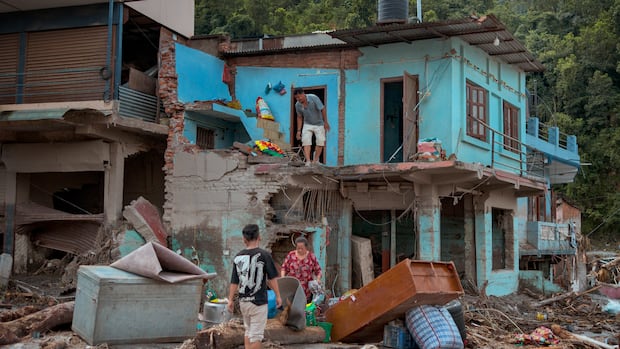

Foreign Affairs Minister Anita Anand confirmed on Friday that among the nearly 2,000 individuals reported missing following a devastating flash flood at the Nepal-Tibet border, there are thirty-two Canadian citizens and permanent residents.
During a press briefing, Anand stated that so far, 579 bodies have been recovered from the area, while 1,924 individuals remain unaccounted for, including 517 foreign nationals.
She noted that no Canadians have been confirmed dead in the tragedy.
“Nepal is currently experiencing a severe humanitarian crisis with widespread destruction,” she remarked.
Additionally, Canada has pledged $5 million to assist with emergency relief efforts in Nepal.
Rescue teams continued their efforts on Friday, navigating through mud and debris in the flood-ravaged regions to locate those who are still missing.
Authorities in Nepal and China have issued warnings about the potential for additional flooding from a lake that formed upstream following Wednesday’s disaster, which is already overflowing. They have advised residents in at-risk areas to seek safer locations.
According to Nepal’s National Disaster Risk Reduction and Management Authority, 3,742 individuals have been rescued so far.
The list of the missing includes tourists from various countries. Brig.-Gen. Raja Ram Basnet, a spokesperson for the Nepalese army, informed The Associated Press that a team was dispatched on Friday to the Upper Trishuli-1 Hydropower Project near the Nepal-China border after reports emerged of people trapped within a tunnel.
“Locating the tunnel’s entry and exit points is complicated due to the mud covering everything,” Basnet explained. “Our top priority is to rescue those who are trapped.”
The rescue mission has proved to be difficult, with limited access to some of the most severely affected communities, as stated by Santosh Pandey, Oxfam’s humanitarian lead in Nepal, during an interview with CBC’s As it Happens from Kathmandu.
“Entire villages and communities have been swept away. There is no one left within the community to assist one another,” Pandey mentioned.
“Many public infrastructures have been destroyed, including hospitals and health facilities, which have been completely wiped out.
“The situation is extremely chaotic at present.”
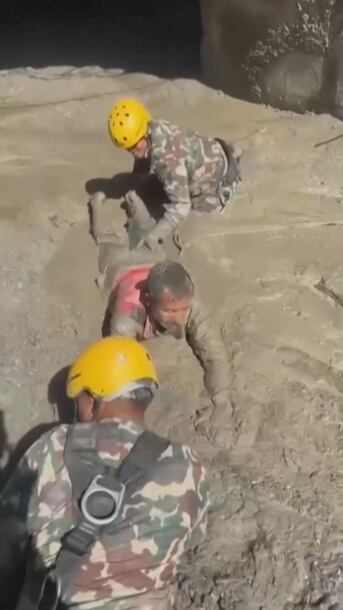
Emergency responders rescued 350 people trapped inside a tunnel, shown in video released by Nepal’s Prime Minister’s Office on Friday. Efforts are continuing to aid more than 100 individuals who remain trapped following Wednesday’s flash flooding that devastated villages and infrastructure in Nepal.
‘We have to find him’
As rescue teams strive to locate the remaining survivors, anxious families have gathered around hospitals to check if their loved ones can be identified among the numerous recovered bodies.
At the Tribhuvan University Teaching Hospital, relatives examine somber images displayed on a wall outside the forensic identification unit.
The images depict the severely damaged bodies of victims, including young children who had been extracted from the mud.
“I came here in hopes of finding [my brother]. I will search until my last breath,” stated Nirmala Sapkota Koholi, 49, a resident of Lalitpur, located south of Kathmandu.
“I must look everywhere; we have to locate him.”
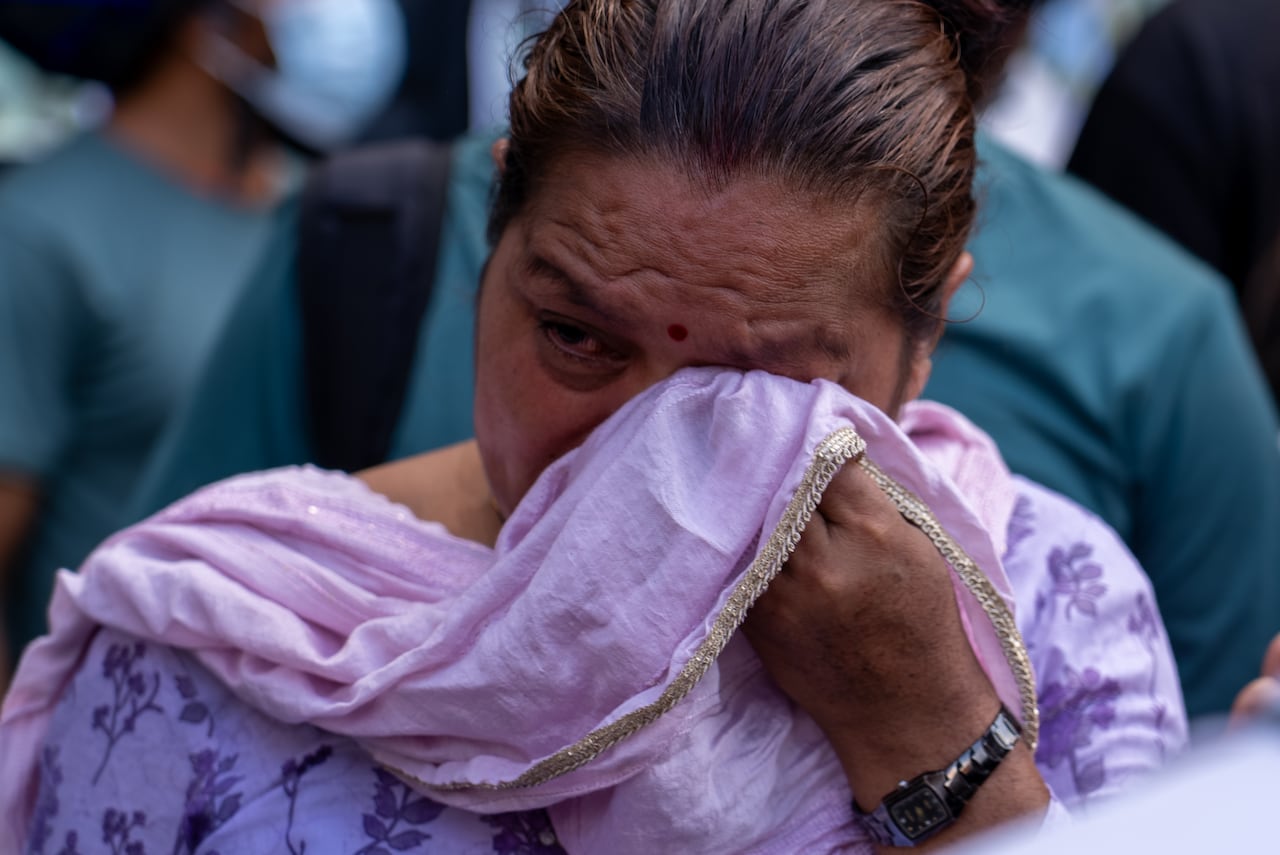
Nirmala Sapkota Koholi, 49, from Lalitpur, is seen searching for her younger brother among photographs lining a wall outside the forensic identification unit at the Tribhuvan University Teaching Hospital in Kathmandu on Friday. (Angela Johnston/CBC)
Koholi shared with CBC News that her younger brother, Pradip Kumar Sapkota, was employed as a driver for a group of pilgrims, which included individuals from the United States and India. He was on a call with his daughter at 8:45 a.m. Wednesday when she heard a loud explosion, and the call abruptly disconnected. They have been unable to contact him since then.
Koholi has visited three hospitals and suspects that one of the victim photos might be her brother.
“He was a very kind person. That is why God took him away.”
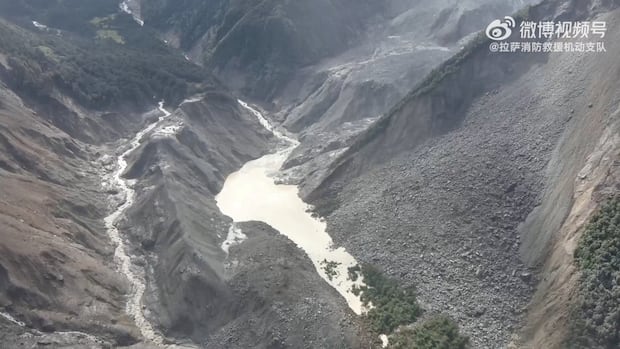
A new lake formed from debris from the glacial collapse on Wednesday has begun to overflow, according to Nepalese authorities, creating an additional flood risk for downstream areas.
Red Cross raises alarm about secondary flood
Officials from the Red Cross expressed their worries about a possible secondary flood during a press conference in Switzerland, noting that the organization’s rescue efforts were temporarily suspended as trucks carrying relief supplies were hindered by additional flooding.
“We estimate that at least 93,000 individuals have been impacted and are in urgent need,” stated David Fisher, head of delegation for the International Federation of Red Cross and Red Crescent Societies in Nepal.
Nepal’s Foreign Ministry mentioned on Friday that while it appreciates the assistance offers from various nations with missing nationals in the disaster, it is currently capable of handling the rescue operations.
Survivors of the flood, including those injured, have been transported to Kathmandu and other locations for treatment.
The affected regions are well-known for trekking and religious pilgrimages.
Vishnuram Ramaswamy, an employee at a private firm in Puducherry, southern India, shared that he last communicated with his mother and two sisters, who were on a pilgrimage to Mount Kailash, on Wednesday morning at 9 a.m.
“This was their first time going on this pilgrimage, and it was something my mother had always dreamed of doing,” he recalled.
Survivor sees ‘black storm’
Customs officer Karbir Gaire is one of the survivors from Timure, the nearest Nepalese village to the Tibet border.
Gaire arrived at his office around 8 a.m. on Wednesday and was working on his computer when he first felt the ground tremble.
“Immediately after the tremor, I noticed a black storm approaching us,” he recounted from Kathmandu, where he has returned to his family. “We all began running out, and within seconds, we were climbing uphill on the opposite side of our office building. I believe those critical seconds saved many of us.”
The disaster originated from a glacier collapse that sent ice and rock rushing downstream, registering as a magnitude-5.2 seismic event according to the U.S. Geological Survey.
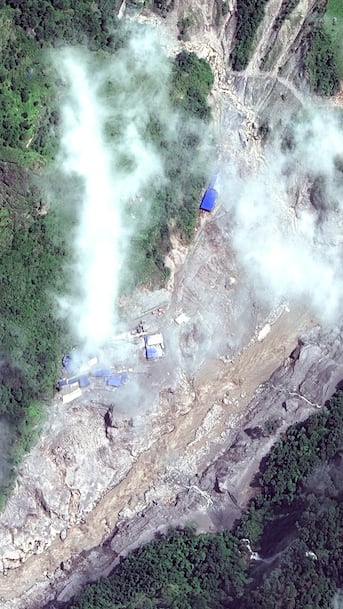
An entire river valley along the Nepal border was wiped out in seconds — but local radar showed no rain, and it wasn’t an earthquake. CBC meteorologist Johanna Wagstaffe explains how a massive glacier collapse triggered a violent inland tsunami, and why geologists warn this unfolding climate disaster isn’t over yet.
Gaire is uncertain about how many colleagues were in the office when the calamity occurred, but 15 of his coworkers are currently missing.
“It felt like a scene from a Hollywood movie. I don’t refer to it as a flood; it was a tsunami,” he expressed.
Gaire described Timure as a lively place filled with government offices, hotels, cafes, banks, primary schools, tea shops, and residential buildings, home to over 1,500 residents.