
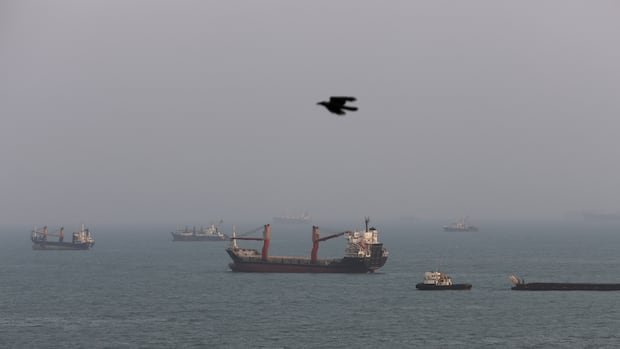

U.S. President Donald Trump stated on Tuesday that there were no ongoing discussions with Iran and emphasized that the Strait of Hormuz was open, contrary to Iran’s claim that the vital water route was closed to shipping. The diminishing hopes of reaching a resolution to the nearly six-month conflict led to an increase in oil prices, a decline in stock markets, and a rise in borrowing costs for major economies, including the U.S., amid concerns about long-term inflationary effects.
Following the expiration of a temporary ceasefire agreement on Monday, a senior Iranian official revealed that Iran was transitioning to a “fully offensive” military stance due to the diplomatic impasse. Despite this, there were no new strikes reported by either side on Tuesday.
Trump, in a post on Truth Social, affirmed, “There are no talks or conversations occurring with the Islamic Republic of Iran.” He also mentioned that the Naval Blockade was in full effect, and all water mines in the Hormuz Strait had been cleared or detonated.
Jared Kushner, Trump’s son-in-law and special envoy, had expressed optimism on Monday, indicating that talks with Iran were still in progress and potentially more substantial than before. The conflict, which commenced with joint U.S.-Israeli strikes on Iran, has reached a stalemate, with Iran threatening shipping in the strait and the U.S. warning of possible renewed attacks if negotiations fail to yield a lasting settlement.
One of the primary U.S. objectives is to prevent Iran from obtaining a nuclear weapon, a challenging task that experts believe requires the removal of enriched uranium believed to be located at previously targeted sites by the U.S.
Despite Trump’s positive outlook on the situation in the Gulf, reports continued to emerge of attempts to disrupt shipping activities. The United Arab Emirates’ Defense Ministry reported detecting two ballistic missiles launched from Iran, the first incident since a strike on the Fujairah port on May 4. The missiles were said to be targeting maritime traffic, according to the UAE, with both missiles falling into the sea. Iran’s foreign ministry spokesperson rejected the accusations, labeling them as baseless.
The UAE Foreign Ministry announced the suspension of all trade activities, exchanges, and financial transactions with Iran due to escalating tensions that jeopardize regional and international peace and security. Direct cargo shipping between the UAE and Iran had only recently resumed in late June via Dubai’s Jebel Ali Port after being halted in early March at the onset of the conflict.
Reports emerged that a vessel transiting through the Strait of Hormuz was struck by an unknown projectile on Tuesday, resulting in engine room damage and injuring a crew member. The Omani Coast Guard was providing assistance to the remaining crew, with no immediate response from Tehran.
Iran’s top negotiator, Mohammad Baqer Qalibaf, declared that the strait would remain closed until the U.S. fulfilled the terms of an interim deal signed in June. These conditions include lifting the blockade on Iranian ports, removing oil sanctions, releasing frozen assets, and ceasing threats and military operations. The 60-day time frame specified in the agreement for a comprehensive deal on Iran’s nuclear program and U.S. sanctions expired on Monday, with Trump indicating no intention to extend it.
The conflict, which disrupted the flow of a significant portion of global oil and liquefied natural gas through the strait, has sparked concerns about economic repercussions and regional stability. Despite Iran’s willingness to engage in dialogue with the U.S., Iranian officials emphasize that negotiations should not be misconstrued as surrender.
As the conflict persists, Iranian leaders are apprehensive about the potential for further economic sanctions to exacerbate hardships, reignite unrest, and undermine the legitimacy of the Islamic Republic. The toll of the conflict has been significant, with casualties reported in Iran and Lebanon, and airstrikes hitting various U.S. military installations and infrastructure across the region.
Oil prices have surged during the conflict, reaching $126 a barrel at its peak, a substantial increase from prewar levels. Brent crude futures settled slightly higher on Tuesday at just over $91 a barrel. The U.S. administration has hinted at the possibility of imposing additional economic sanctions on Iran in the coming months.
Overall, the situation in the region remains tense, with ongoing uncertainties surrounding diplomatic efforts, security concerns, and economic stability.