
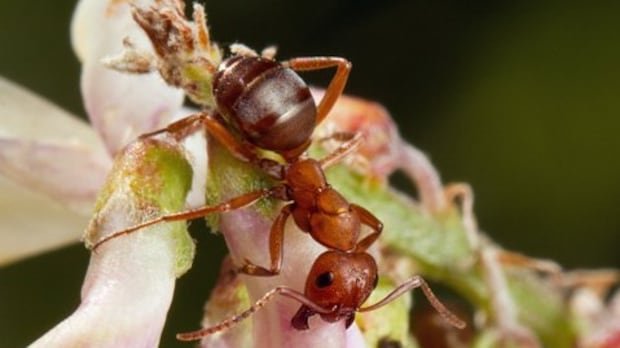

In the southeastern region of Alberta, the Cypress Hills present a striking visual contrast against the flat prairie landscape. Below the scenic surface, a fascinating natural drama unfolds. Ants in Cypress Hills Provincial Park find themselves unwittingly clinging to plants and shrubs, awaiting the chance to be consumed by unsuspecting herbivores. The mastermind behind this eerie scenario is the parasite known as Dicrocoelium dendriticum, a worm with the uncanny ability to manipulate its host.
Experts from the University of Calgary and University of Lethbridge have identified Dicrocoelium dendriticum as a standout among parasite manipulators due to its unique capability to switch its control mechanism on and off, a phenomenon unparalleled in the realm of parasitic zombification.
Zombie parasites are a prevalent occurrence in nature, with nearly every species hosting or being affected by manipulative parasites seeking to advance their life cycles. From the well-known Cordyceps fungus to the horsehair worm that coerces crickets into waterborne suicide missions, these parasitic relationships typically culminate in the demise of the host. However, Dicrocoelium dendriticum breaks this pattern by incentivizing host survival to complete its complex life cycle, involving multiple hosts ranging from snails to grazing mammals.
The intricate life cycle of Dicrocoelium dendriticum begins with eggs excreted by final hosts like elk or deer, which are ingested by snails and develop into larval forms called cercaria. These larvae are then consumed by ants, with one cercaria infiltrating the ant’s brain while others migrate to the abdomen, awaiting ingestion by grazing mammals. To facilitate this transition, the brainworm manipulates the ant’s behavior, compelling it to climb vegetation and increase the likelihood of being consumed.
However, this strategy poses risks for the manipulated ants, exposing them to predators, dehydration, and starvation. To mitigate these dangers, the parasite employs an intriguing mechanism that allows the ants to detach from plants and return to their nests when conditions are unfavorable. The ability to adjust behavior based on external factors like temperature raises questions about the intricate control mechanisms employed by the parasite.
Researchers are delving into the genetic and biochemical changes induced by the parasite to decipher the mechanisms behind this complex manipulation. By studying the alterations in biochemical pathways and gene expression during the zombification process, scientists aim to unravel the secrets of how Dicrocoelium dendriticum exerts its mind-controlling influence.
The insights gained from studying this parasitic relationship not only shed light on the intricate workings of nature but also offer valuable lessons on human-induced environmental changes and disease transmission. The accidental introduction of Dicrocoelium dendriticum to Canada through historical animal imports underscores the impact of human activities on ecological balance, highlighting the need for a deeper understanding of these complex interactions to inform disease management strategies.