
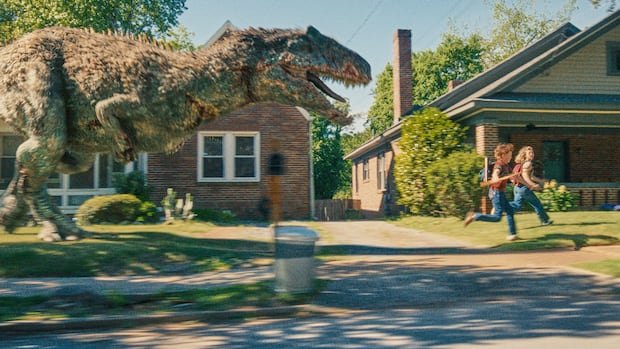

A massive serpent-like entity emerges from a nearby pool, while feathered reptiles pursue a family along their driveway. Two colossal furry creatures rest against a house and engage in mating behavior in “The End of Oak Street,” the latest film entering theaters inspired by dinosaurs and a fondness for “Jurassic Park.”
Despite Hollywood’s long-established tradition, these ancient creatures in the movie show noticeable differences from their cinematic predecessors, reflecting an awaited upgrade according to paleontologists. Inquiring about the accuracy of the movie’s portrayal of feathers and wildlife, CBC News consulted experts to discuss the accuracies and liberties taken by filmmakers to fill gaps in the still incomplete fossil record.
One burning question: did dinosaurs really copulate in the depicted manner? From a scientific viewpoint, that particular aspect may not be the most intriguing part.
Victoria Arbour, a paleontologist at the Royal B.C. Museum, praised the film for showcasing abundant feathers on dinosaurs, a departure from previous portrayals even in recent “Jurassic World” movies. The depiction of dinosaurs in Hollywood has long trailed behind scientific discoveries, as the relationship between dinosaurs and birds has been suspected since the early days of evolutionary theory.
Fossil findings since the 1990s have significantly expanded evidence supporting the presence of feathers on many non-avian dinosaurs. Discoveries like Sinosauropteryx prima in China, the first non-avian dinosaur with clear feather evidence, have revolutionized scientists’ understanding of dinosaurs. The prevalence of feathers in dinosaurs has only begun to gain recognition in the last two decades, challenging the scaly image popularized by “Jurassic Park.”
“The End of Oak Street” boldly incorporates feathers in ways seldom seen in dinosaur films. The decision to portray an Allosaurus with feathers, often mistaken for a T. rex, is deemed plausible by Caelan Libke, a Carleton University PhD student specializing in dinosaur research. While some creatures in the film appear to be artistic inventions, their depictions align with plausible interpretations based on scientific knowledge.
The film introduces imaginative creatures, such as a massive legless aquatic animal reminiscent of the giant prehistoric snake Titanoboa. However, these creatures are not scientifically documented and are purely speculative creations for entertainment.
The movie also portrays furry sauropods, a dinosaur group that includes the controversial Brontosaurus, with an exaggerated amount of fur. The film depicts these creatures engaging in mating behavior, a scenario that poses challenges due to the lack of preserved soft tissue in dinosaur fossils.
The mechanics of dinosaur mating remain a mystery due to the scarcity of evidence and the challenges of interpreting behaviors from incomplete skeletons. With limited information on dinosaur reproduction, paleontologists must tread carefully when reconstructing these ancient creatures’ behaviors.
The depiction of dinosaur mating in “The End of Oak Street” may not align precisely with scientific understanding, but it does not veer into the realm of impossibility according to experts. The film’s portrayal of dinosaur behavior remains within the realm of speculation, acknowledging the enduring mystery surrounding dinosaur reproduction.
Overall, the film’s imaginative take on dinosaur characteristics and behaviors adds a fresh perspective to the cinematic portrayal of these ancient creatures, aligning more closely with current scientific understanding.