
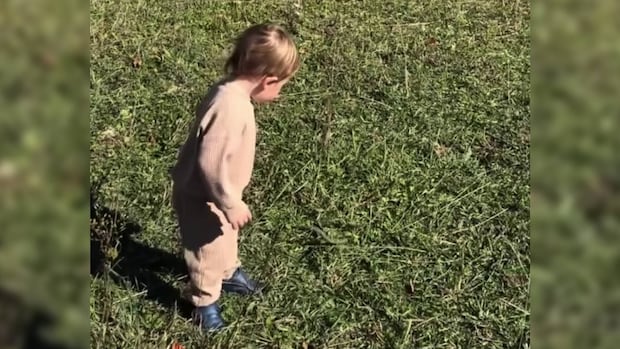

A 15-month-old child from Sarnia, Ontario, is recuperating at home after suffering a rattlesnake bite at a family cottage during the Thanksgiving long weekend. His treatment involved visits to two hospitals and required a total of 18 doses of antivenom.
Wells Gladwish was bitten on his thumb around 12:45 p.m. on Sunday while enjoying the afternoon with relatives at their cottage located in Cape Chin North, situated on the Bruce Peninsula.
According to his father, Matt Huggett, the young boy was walking near a family bonfire when he encountered the snake and attempted to pick it up. The snake then bit Wells on the thumb, which started to turn white within approximately five minutes.
“We realized immediately that we were in a serious situation,” Huggett stated. “The closest hospital was in Lion’s Head, and we did everything we could to get him there as quickly as possible.”
Medical staff at Lion’s Head Hospital faced multiple challenges in starting an IV for the energetic toddler. After administering a test dose to check for any severe allergic reactions, the team provided 10 vials of antivenom, with the hospital having a total of 14 vials on hand.
A family member managed to take a photograph of the snake, which was confirmed to be an eastern massasauga rattlesnake, the only venomous snake species found in Ontario, residing along the eastern shore of Georgian Bay and on the Bruce Peninsula.

A family member photographed the snake that bit Wells Gladwish. It was identified as an eastern massasauga rattlesnake. (Matt Huggett)
Transfer from Lion’s Head to London
Huggett mentioned that doctors and toxicology experts coordinated an urgent response and determined that Wells required further treatment at London Health Sciences Centre (LHSC), Victoria Hospital.
While an Ornge air ambulance was arranged for a transfer, Huggett noted that repeated delays and cancellations left the family waiting as the swelling progressed. A nurse at Lion’s Head advocated for Wells to receive the remaining four vials of antivenom available and to be transported to London via land ambulance.
“We could no longer afford to wait for Ornge to make a decision,” Huggett remarked. “They eventually placed him in an ambulance.”
After a three-hour journey by ambulance, Wells reached LHSC’s Pediatric Critical Care Unit.
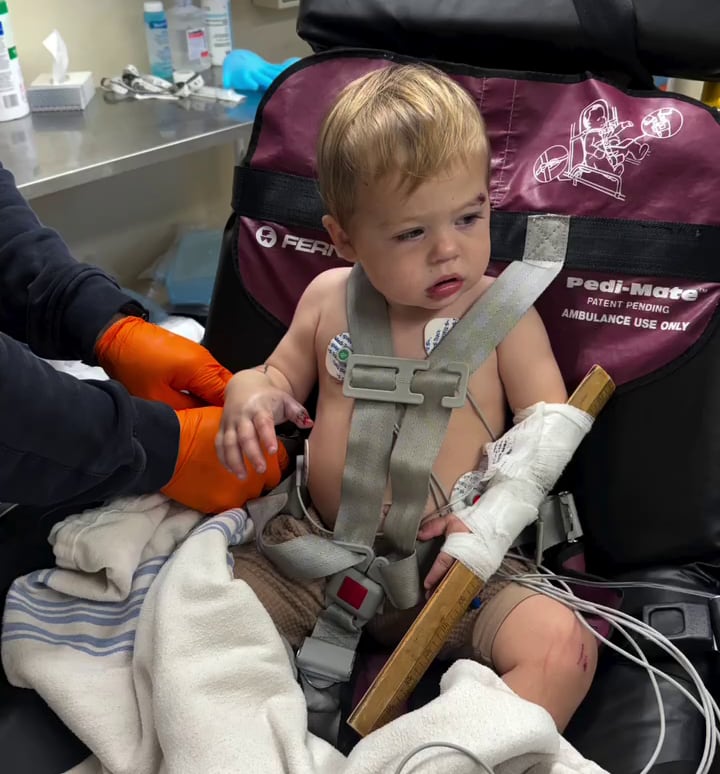
Wells Gladwish was eventually taken to the Children’s Hospital in London, Ont., for additional treatment for a rattlesnake bite (Matt Huggett)
Dr. Rishi Ganesan, a pediatric critical care physician at LHSC’s Children’s Hospital, stated that his primary concern upon receiving the call was to assist Wells and secure antivenom, as it is not kept in stock at the London facility.
He acknowledged the Lion’s Head team for having antivenom readily available and administering it promptly. Ganesan noted that they obtained additional antivenom and transported it to London under police escort from the Toronto area to ensure it was available upon Wells’s arrival.
Wells received two additional double doses while in London, resulting in a total of 18 doses administered.
Ganesan shared that he had not treated a venomous snakebite in his ten years of practice in Canada, but his training in India proved beneficial.
“I trained in India many years ago, and I have managed snakebites of various kinds: cobra, viper, krait,” he explained. “Some of that knowledge came back to me, and I felt quite at ease.”
Ganesan explained that antivenom is derived from horses and can provoke severe allergic reactions, which is why the initial dose must be given cautiously with proper monitoring.
He emphasized that children do not necessarily require less antivenom than adults. The treatment is tailored to the amount of venom, rather than the patient’s size, and children may become critically ill more swiftly because the venom affects them more significantly relative to their body weight.
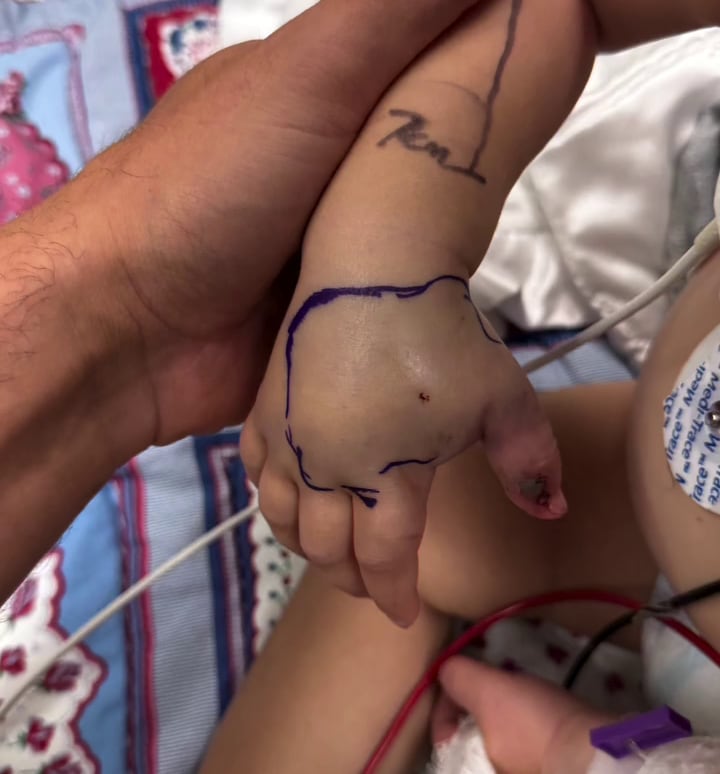
Doctors treated Wells for a rattlesnake bite with 18 doses of antivenom. (Matt Huggett)
Medical professionals monitored Wells’s swelling and conducted blood tests to assess whether additional antivenom was necessary. The venom can cause tissue damage and disrupt blood clotting, while severe swelling can also impede blood flow to the affected limb.
“Antivenom does not resolve all the complications associated with snake envenomation,” Ganesan stated. “It is certainly the foundation of treatment.”
He mentioned that prompt treatment usually results in favorable outcomes, and he does not expect significant long-term issues for Wells.
‘Incredibly thankful’
Huggett expressed that many of the medical staff had never encountered a case like Wells’s previously, yet they collaborated and sought expert advice to ensure proper care.
Ganesan also commended the teamwork among hospitals, pharmacists, the Ontario Poison Centre, and other specialists who played a role in securing the necessary medication.
“This was an extraordinary experience,” he remarked. “Countless individuals came together and contributed in various ways to ensure that he received the best care possible.”
Wells was moved to the children’s inpatient unit before being discharged and returning home to Sarnia.
His father noted that Wells seems to be using his thumb without issues, although a blister remains at the site of the bite. The family continues to monitor his recovery and is vigilant for potential serum sickness, a delayed reaction to antivenom.
“We are not ready to say we are completely out of the woods yet,” Huggett stated. “But he is using it right now, appears happy, and it seems to be improving.”
What to do if bitten
Ganesan advised that anyone bitten by a rattlesnake should treat it as a medical emergency and call 911 immediately.
While not every bite injects venom, he emphasized that it is impossible to determine that reliably in the field.
“With prompt medical attention, a full recovery is typically achievable in these situations,” he stated. “The true risk lies in the delay, not the snake itself.”
Eastern massasauga rattlesnakes generally avoid human interaction and are likely to bite only when provoked, threatened, or accidentally stepped on, Ganesan noted.
He recommends that individuals hiking or spending time outdoors in regions where these snakes reside should be mindful of where they step, refrain from reaching into bushes or hidden areas without proper inspection, and to leave any encountered snake alone.