

On Thursday, rescue crews were actively searching for hundreds of individuals reported missing along the border between Nepal and Tibet. This followed a devastating surge of water and mud that inundated communities a day prior due to a glacier collapse.
According to reports from authorities in Nepal and China, The Associated Press has indicated that over 390 people have died, with more than 1,400 individuals still unaccounted for. Reuters has reported at least 359 fatalities and nearly 1,000 missing, including citizens from various countries around the globe, after the flash floods struck on Wednesday morning local time.
Anita Anand, the Foreign Affairs Minister, stated that the government is “aware of 30 Canadians and permanent residents in Nepal and the Tibet region whose locations and conditions have yet to be verified.” She emphasized that this number may fluctuate due to the challenging conditions on the ground, which have included difficulties with communications.
A family member of Dhaval and Megha Shah confirmed that the couple from Port Moody, B.C., is among the Canadians reported missing.
Nikita Shah, Dhaval’s cousin, mentioned that the couple was on a “spiritual journey” in Nepal, with their last communication occurring on Tuesday night.
Shah indicated that the couple was residing at Hotel Kailash.
“We are uncertain about the status of the infrastructure there; we are receiving a lot of misinformation, so it would be immensely helpful if the Canadian government could assist,” Shah stated. “The Canadian government needs to take action regarding this situation.”
Global Affairs Canada confirmed in a statement that it is dispatching five consular officials to Kathmandu to assist Canadians and coordinate with local authorities.
“We are working closely with our Nepalese and Chinese counterparts, and we are also collaborating with international partners and allies who have citizens in the affected area,” the statement read.
The Nepal Tourism Board, which has released figures regarding the missing from various nations, previously noted that 25 Canadians were among those unaccounted for.
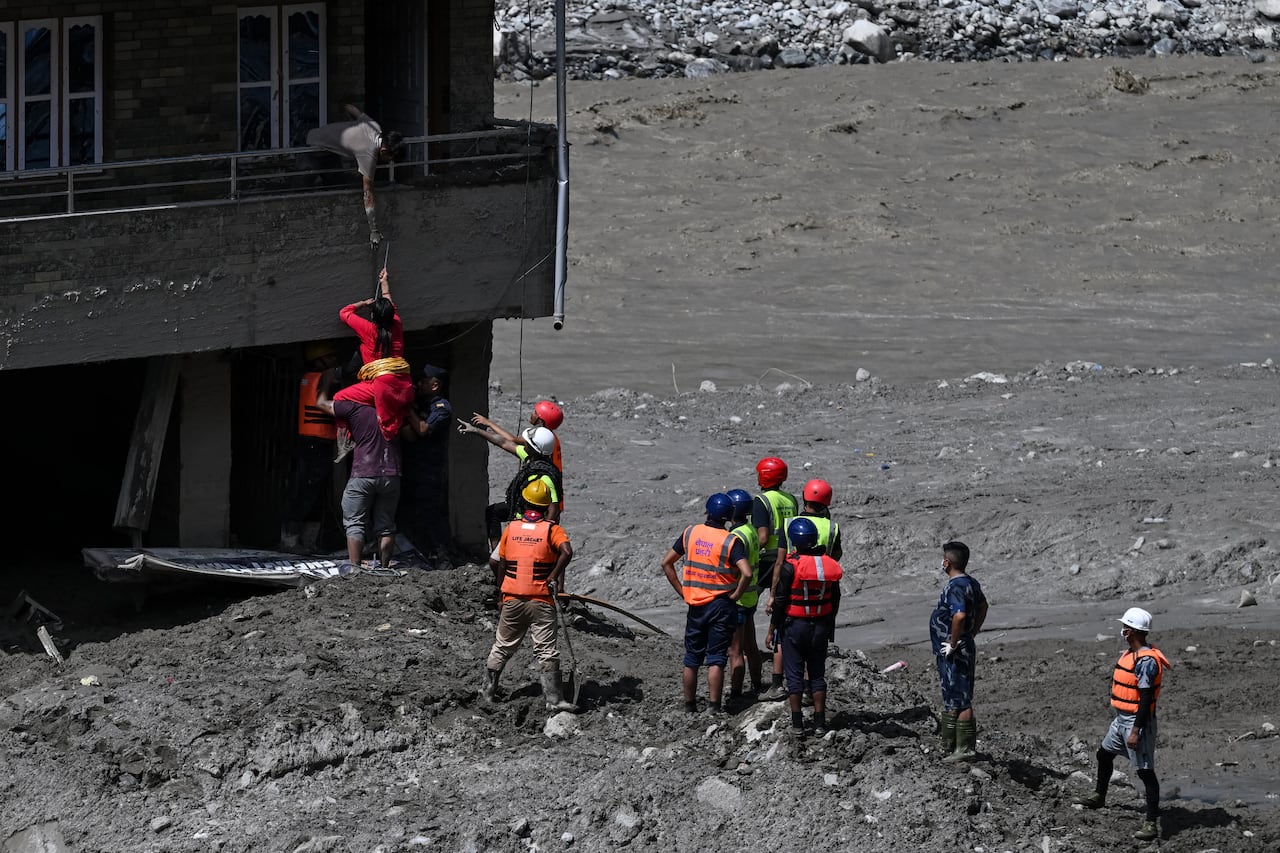
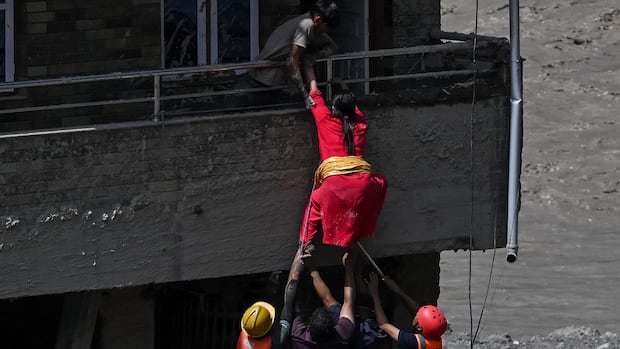
Police personnel rescue stranded residents from houses lying deluged in sludge after flash floods at Trishuli in Nepal’s Nuwakot district on Thursday. (Arun Sankar/AFP/Getty Images)
The steep valleys in the region serve as crucial economic routes, yet they become perilous during disasters. Images depicted the upper levels of buildings in Nuwakot coated in mud following the deluge. Debris was seen hanging from trees and wires, vehicles were buried, and some shocked survivors were covered in mud.
“When I reached Dhunge bazaar, within half an hour, the flood came and destroyed the entire market. People were preparing to head to work at that time,” said local resident Shoyam Rajbhandari. “We have no idea how many are missing or deceased.”
UN taps into rescue fund
Tom Fletcher, the humanitarian chief of the United Nations, announced on Thursday that he has authorized the allocation of $2 million US from the UN’s Central Emergency Response Fund to assist with medical services, shelter, and water supply.
Fletcher mentioned that emergency teams were mobilized and additional teams were on standby.
The majority of the fatalities and 826 reported missing individuals were in Nepal, with three dead and 558 unaccounted for in Tibet, according to authorities. The Nepal Tourism Board stated that 517 of the missing individuals in the country were foreigners, with 178 hailing from India.
-
Flash floods kill more than 160 in Nepal, Tibet
-
Video
Hundreds of people, including tourists, missing after flood in Nepal
Additionally, Lin Jian, spokesperson for China’s Ministry of Foreign Affairs, stated that nearly 100 Chinese citizens were unaccounted for on the Nepalese side.
Nepalese officials reported that numerous bridges were destroyed and around 40 kilometers of roads sustained damage, hindering search operations.
The Nepalese army successfully rescued over 100 individuals from flood-affected areas via helicopter operations on Thursday morning, as reported by army spokesperson Brig. Gen. Raja Ram Basnet.
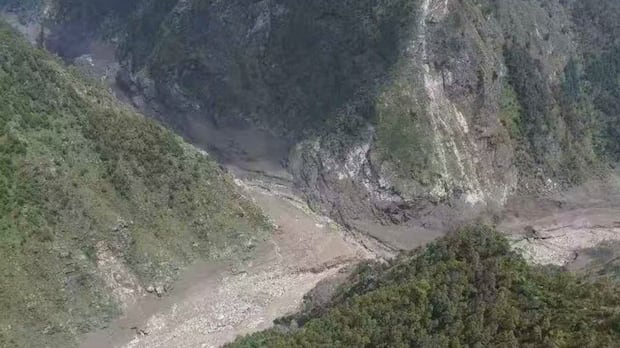
An entire river valley along the Nepal border was wiped out in seconds… but local radar showed no rain, and it wasn’t an earthquake. CBC Meteorologist Johanna Wagstaffe breaks down how a massive glacier collapse triggered a violent inland tsunami—and why geologists warn this unfolding climate disaster isn’t over yet.
At least eight foreign nationals were airlifted to the capital city, Kathmandu, he stated, adding that army teams also rescued individuals trapped within facilities linked to the Trishuli hydropower project.
Rescue teams discovered bodies approximately 100 kilometers downstream from the site of the disaster in Chitwan district. Many injured individuals have been transported to Kathmandu for advanced medical treatment.
Bishal Kumar Bhandari, chairman of the Nepal Red Cross Society, indicated that efforts have now shifted from rescue operations to large-scale relief initiatives in the flood-impacted districts. He reported that around 1,200 individuals have been displaced from at least three villages.
In Tibet, a mudslide near the land border crossing at Gyirong Port on Wednesday resulted in mud accumulation averaging over 1.5 meters deep in surrounding areas, with some road segments exceeding two meters, as reported by Chinese state broadcaster CCTV. Roads leading to the port sustained damage, and the risk of secondary collapses or landslides remains as rainfall continues in the region.
Melting glaciers becoming more frequent
The U.S. Geological Survey (USGS) initially reported a magnitude 4.4 earthquake early Wednesday, about 66 kilometers north of Kathmandu, close to the border.
The USGS later revised its findings, stating that the seismic event was actually a magnitude 5.2 glacier collapse that caused debris to flow downstream with devastating effects on local communities. Their conclusion was based on data from nearby seismic stations, analysis of long-period seismic waves, and satellite imagery, confirming that no earthquake had occurred.
Experts in climate at the International Centre for Integrated Mountain Development in Kathmandu suggested that an avalanche from a glacier likely initiated the flash flood on Wednesday.
“Hydrological data indicates the extraordinary velocity and scale of the flood wave,” they stated in an email, noting that water levels on the Trishuli river surged by as much as nine meters in just half an hour.
They highlighted that the Lhende Khola River, a tributary of the Bhotekoshi, experienced the most significant flooding.
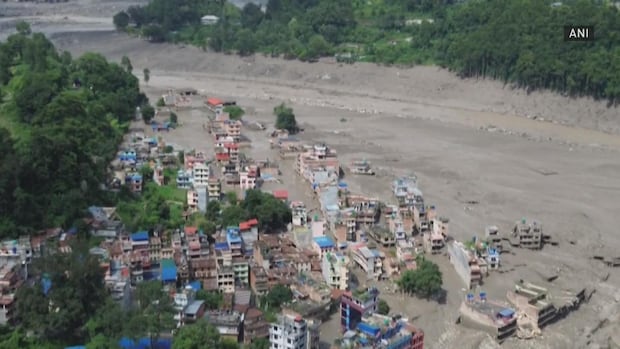
Video captured by a drone shows the impact of floodwaters in parts of Nepal’s Nuwakot district, where some riverside buildings were left surrounded by mud.
The steep inclines and fertile valleys below the Himalayan mountain range, extending across multiple Asian nations, are particularly susceptible to flooding and landslides. The frequency of melting glaciers has increased due to rising temperatures linked to human-induced climate change.
Researchers based in Kathmandu found earlier this year that glaciers throughout the Hindu Kush Himalaya region are melting at an accelerated pace, with ice loss rates having doubled since 2000.
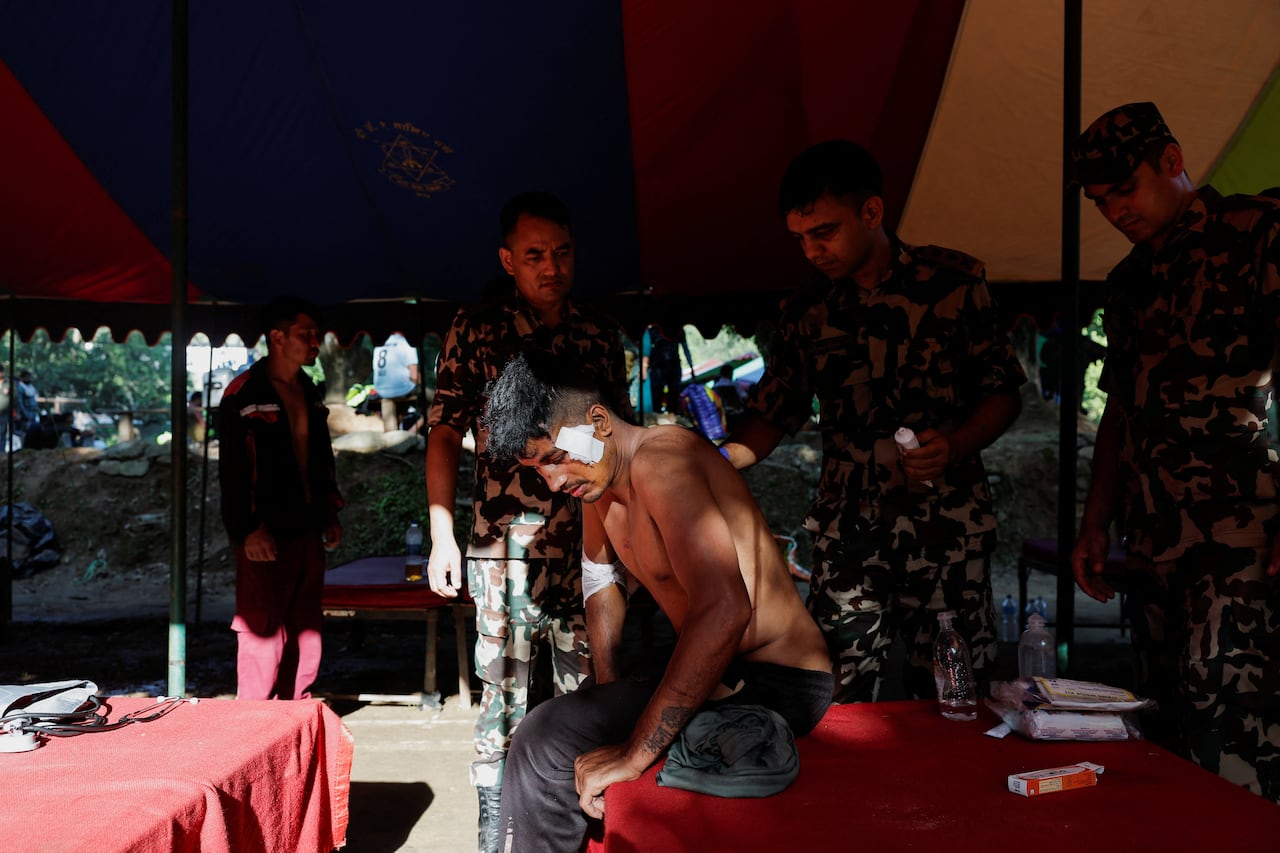
A man who was airlifted from Rasuwa district receives first aid at a mobile hospital staffed by army personnel in Trishuli, in Nuwakot district, Nepal. (Navesh Chitrakar/Reuters)