
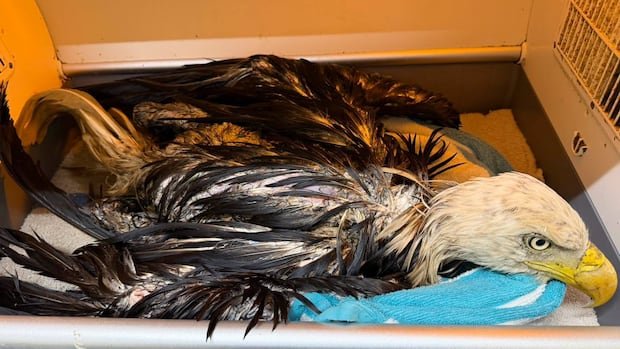

A soaked bald eagle that couldn’t fly was rescued from a dump in Brantford, Ontario, and is now recuperating at a wildlife rehabilitation center. Bylaw officers faced challenges but managed to extract the eagle from the Brantford Landfill Site Scale on Monday. Chantal Theijin, the authorized wildlife custodian at Hobbitstee Wildlife Refuge in Nanticoke, described the eagle as extremely wet and emitting a foul odor resembling a drowned rat when they opened the box she was in.
Theijin speculated that the eagle was likely foraging at the dump during heavy rains that hit parts of Ontario on Monday. She mentioned that it’s not uncommon for majestic eagles to frequent garbage dumps. The eagle is currently under care and will require some time before being released from the refuge.
Ian Harrower, supervisor of bylaw compliance at the City of Brantford, shared that he received a report about an immobile eagle at the dump. It took a team of six individuals to rescue the persistent bird. Harrower described the rescue operation as an unexpected adventure near wet garbage and mud, with staff using dirt bikes to guide the eagle towards them on foot for capture.
The rescue effort lasted about 40 minutes, with the bird finally being cornered and captured with the help of staff jackets. Fortunately, the bird did not have a broken wing as initially feared. The eagle was transferred to Hobbitstee Wildlife Refuge for further care with the assistance of Hillside Kennels Animal Control.
Theijin noted that eagles are a common rescue at the refuge, with the current eagle receiving significant attention. The refuge, funded solely by community donations, cares for various wildlife species without charge. The injured eagle is expected to recover within two to four weeks, needing time for its feathers to heal from the washing process and the presence of an unknown substance affecting its natural oils.
Despite the eagle’s relatively cooperative behavior, Theijin mentioned the bird’s intense gaze, indicating a readiness to defend itself. She expressed that working with wildlife entails being disliked by them, a sign of their recovery and readiness to return to the wild.