
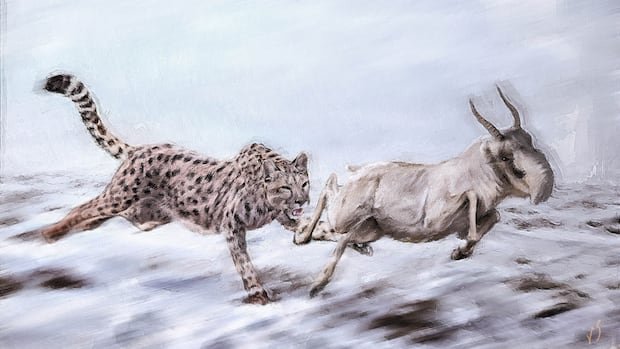

The discovery of bones initially presumed to be from an ice-age puma or cougar in the Bluefish Caves and a mine site in northern Yukon took an unexpected turn after DNA analysis conducted by the University of California. The examination, carried out by Molly Cassatt-Johnstone, a recent graduate at the time working as a lab technician, revealed that the bones were not from pumas but from cheetahs.
Grant Zazula, a Yukon paleontologist, vividly recalls his surprise upon receiving the message informing him that the previously identified cougars were actually cheetahs. He noted the significant advancements in genetic analysis over the years, emphasizing that the examination of genetic material from permafrost-preserved bones is now a routine practice.
Cassatt-Johnstone’s identification of the Yukon Miracinonyx, also known as the extinct American cheetah, marked a groundbreaking moment. She is now the lead author of a research paper published in Current Biology that provides new insights into the ice-age cat’s dietary habits and habitat.
‘A Fascinating Investigation’
Previously, experts believed that the American cheetah, resembling modern cheetahs with their long limbs and sleek physique, would have evolved to pursue pronghorns across grassy plains. The discovery of these creatures in the Arctic tundra puzzled paleontologists.
Cassatt-Johnstone explained that the cheetahs were initially thought to be specialized predators of American pronghorn antelope in the lower 48 states, although no pronghorn were found in Beringia, the region where Asia and North America were once connected, encompassing present-day Russia’s easternmost area, Alaska, and the Yukon.
To unravel the mystery of how Miracinonyx survived in this environment, researchers collaborated with experts from Canada and the U.S. to conduct stable isotope analysis. This method, commonly used in forensic investigations, involves examining chemical traces in bones to determine dietary patterns, environmental conditions, and potential migration routes.
Analyzing bone fragments from the cheetah’s limbs using a precise process, Matthew Wooller, director of the Alaska Stable Isotope Facility at the University of Alaska Fairbanks, likened the accuracy of the analysis to distinguishing between plain carrots and carrot cake based on isotopic data.
The study revealed that Yukon cheetahs predominantly consumed fish, a behavior uncommon among historical and present-day felines. Researchers believe this dietary choice was influenced by the ecosystem dynamics, presenting a complex puzzle to solve.
‘Salmon Enthusiasts’
This dietary revelation astonished paleontologists like Julie Meachen, a specialist in Late Pleistocene mammalian carnivores who has extensively studied this species in Wyoming. She emphasized the distinct behavior of Yukon cheetahs compared to their counterparts in midcontinental North America, suggesting that the abundance of Yukon salmon might have been a key factor in their survival strategy.
The study’s genetic analysis confirmed that Miracinonyx was genetically closer to North American pumas than African cheetahs. Additionally, the examination of the cats’ genetic diversity indicated historically low population numbers, potentially contributing to their extinction.
Zazula proposed renaming this unique northern population from ‘American Cheetah’ to ‘Yukon Cheetah,’ highlighting the significance of this discovery in expanding our understanding of the region’s prehistoric fauna.
“The unearthing of arctic fishing felines underscores the continuous potential for new discoveries in paleontology,” Zazula remarked, underscoring the perpetual fascination of exploring the past through fossil remains.