
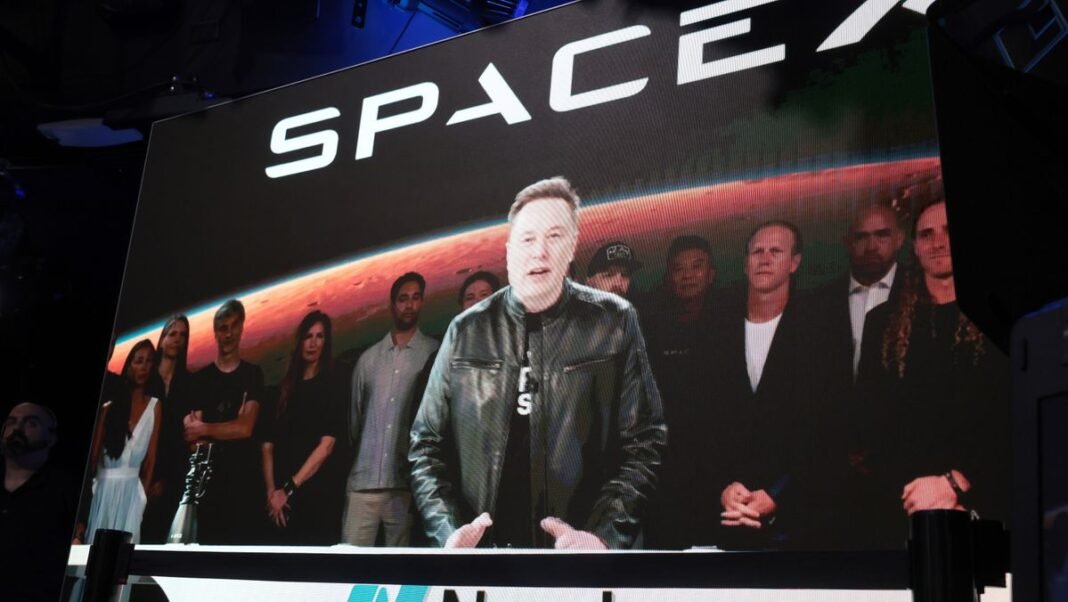

Business magnate Elon Musk has achieved the remarkable feat of becoming the world’s first trillionaire following the soaring success of his SpaceX company’s stock market debut.
Musk, already renowned as the wealthiest individual globally, holds a substantial 42% stake in the space exploration and AI enterprise. Combining this with his shares in Tesla, the surge in SpaceX’s value propelled the 54-year-old’s personal wealth past the $1 trillion mark.
Marking the commencement of trading on the Nasdaq, Musk expressed astonishment, stating, “It’s incredible to think that a small company that originated in a warehouse in El Segundo is now going public in the largest IPO ever. If someone had told me this would happen, I would have thought they were being overly optimistic because I believed it might fail. I only gave SpaceX a 10% chance of success. In fact, I even mentioned to people that it might fail, but we should give it a shot.”
The controversial entrepreneur has widened the wealth gap between himself and other billionaires like Amazon’s Jeff Bezos, and Google’s co-founders Larry Page and Sergey Brin.
Nevertheless, Oxfam has raised concerns about Musk’s anticipated trillionaire status, labeling it “a dark day for global democracy.” According to their analysis, his wealth would surpass that of the poorest 3.8 billion individuals on Earth, constituting 46% of the global population.
Following SpaceX’s IPO, its shares surged by 20% to $165 in early Nasdaq trading before stabilizing at $150, well above the initial $135 price, resulting in a market value of approximately $2 trillion (£1.5 trillion).
SpaceX disclosed the sale of $75 billion (£55 billion) worth of shares priced at $135 (£100) each. Despite the company’s profitability, there was a high demand for shares, with the offering oversubscribed by three to four times.
SpaceX has evolved into a conglomerate encompassing a wide array of ventures ranging from space rockets and Starlink satellites to AI and X, previously known as Twitter.
Approximately 20% to 25% of the stock was anticipated to be available to retail investors rather than institutions, a significantly higher proportion compared to other IPOs. The overwhelming response was evident as around £75 billion worth of orders originated from individual investors. In the UK alone, about 2.7 million shares were purchased in the offering through Marex Financial.
While the IPO unfolds in New York, UK investment platforms have extended the opportunity for Britons to acquire SpaceX shares. Additionally, numerous ordinary individuals are poised to indirectly own a share through their pension funds’ automatic investments.
Dan Coatsworth, markets head at AJ Bell, remarked that retail investors participating in SpaceX’s IPO are likely delighted with the outcome. An investment of £2,013 in 20 shares could now be valued at £2,236, yielding a paper gain of £223. Coatsworth emphasized that realizing a profit would require selling the shares at a higher price, which could take time.
The IPO marked the largest share sale in history, eclipsing the previous record set by state-owned oil giant Saudi Aramco in December 2019. Aramco raised £19 billion in its IPO on Riyadh’s exchange, valuing the company at nearly £1.3 trillion.
SpaceX is the pioneer of a trio of companies poised to enter the stock market with valuations exceeding $1 trillion, with AI competitors Anthropic and OpenAi set to follow suit.
Mike Ambery, retirement savings director at Standard Life, emphasized the impact of major IPOs like SpaceX on pension savers, highlighting the potential for exposure to such companies through diversified funds and global market indices.
Investors backing SpaceX are essentially endorsing Musk’s leadership in driving a substantial revenue surge, particularly through the AI sector. SpaceX projects a vast market opportunity exceeding £21 trillion.
Susannah Streeter, chief investment strategist at Wealth Club, anticipates a significant surge in SpaceX shares as trading commences on Nasdaq, attributing this to heightened investor demand. She also predicts potential market volatility and portfolio realignments in the tech sector.
Despite the astronomical figures involved, skepticism has surfaced regarding SpaceX’s lofty valuation. Independent research firm MorningStar suggests that SpaceX’s shares may be overvalued, estimating