
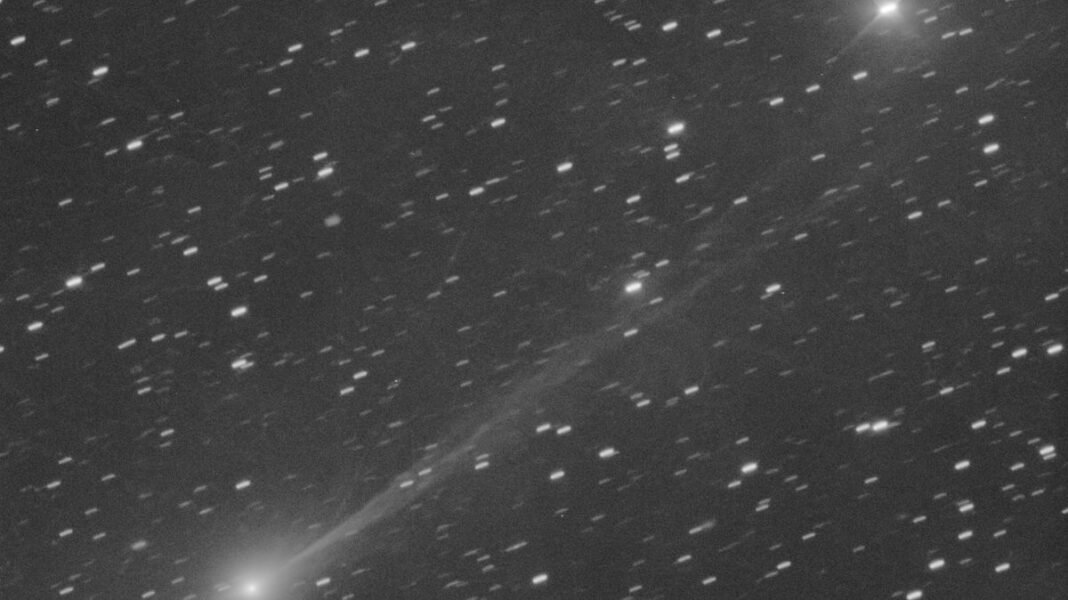

NASA has unveiled stunning pictures of a comet from another star passing through our solar system. Referred to as 3I/Atlas, it marks only the third confirmed interstellar object in our solar system. The images of the comet were showcased at a recent press briefing by the space agency.
Several NASA spacecraft near Mars captured images of the comet as it journeyed through space, coming within about 18 million miles of the spacecraft. Presently, the comet is approximately 190 million miles away from Earth and is expected to approach as close as 167 million miles in mid-December before heading back into interstellar space.
Gianluca Masi of the Virtual Telescope Project also focused on the comet, which was first detected this summer, during an observation from Italy. The comet can also be viewed from Earth in the early morning sky using binoculars.
Tom Statler, the lead scientist for solar system small bodies at NASA, mentioned that the images are raw and hold valuable data that the scientific community will analyze for years to come.
Named after the observatory in Chile where it was first sighted, 31/Atlas generated online speculations suggesting it could be a spacecraft. Although Harvard astrophysicist Avi Loeb initially proposed this idea, he later acknowledged that the object is most likely a natural comet.
This speculation attracted significant attention online, even prompting celebrity Kim Kardashian to inquire with NASA Acting Administrator Sean Duffy about the details surrounding 3I/Atlas. Duffy, appointed by President Donald Trump, responded by affirming that there are no aliens and no threat to Earth.
At the recent press conference, NASA Associate Administrator Amit Kshatriya dispelled rumors about the origins of 3I/ATLAS, emphasizing that all indications point to it being a natural comet from another star system.
The European Space Agency’s Juice spacecraft has been observing the comet throughout the month, anticipating high activity levels. However, due to the spacecraft’s main antenna serving as a heat shield near the Sun, data transmission is restricted, and scientists may not receive the observations until February.