
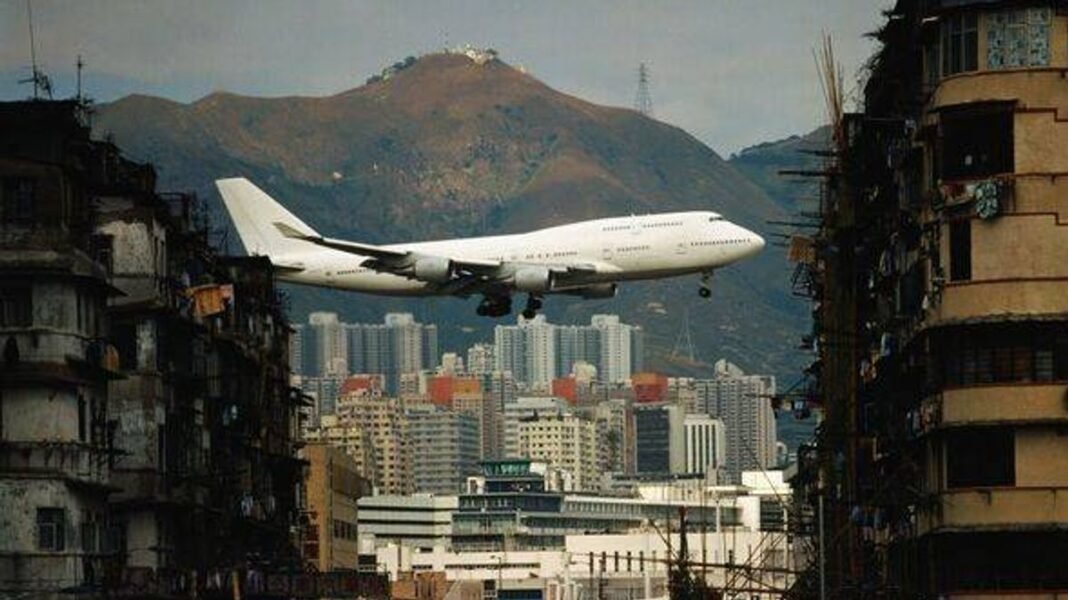

The airport at Kai Tak in Hong Kong was notorious for being a challenging landing spot even for experienced pilots. Situated amidst skyscrapers, mountains, and Victoria Harbour, it posed a daunting task for aviators. For over 73 years, millions of passengers held on tight as planes descended into the city, flying past apartment buildings so close that details of daily life were visible. Pilots had to execute a sharp 47-degree turn known as the ‘Hong Kong Turn’ just before landing, aiming their jumbo jets at a distinctive red-and-white checkerboard on a hill, requiring precise skill to avoid mishaps.
Historical footage captured the intense landings, showcasing planes battling strong crosswinds, tilting over busy streets, and landing with impact on a runway that ended near the harbor. Dubbed ‘Kai Tak Heart Attack,’ the airport rattled residents below with roaring engines, laundry being swept away, and the entire city tensing up during stormy weather.
Despite its fearsome reputation, Kai Tak played a vital role as a hub for airlines like Cathay Pacific and Dragonair, contributing significantly to Hong Kong’s economy. However, due to space constraints and noise pollution concerns, a decision was made to build a new airport on Chek Lap Kok Island, leading to Kai Tak’s closure on July 6, 1998. The airport’s final departure drew crowds to bid farewell to an era.
Although Kai Tak was intimidating, it also inspired admiration for its aviation challenges that only the most skilled pilots could conquer. Today, the former airport site has undergone a remarkable transformation into a vibrant district as part of Hong Kong’s harborfront development project. The old runway has been repurposed into the futuristic Kai Tak Cruise Terminal, hosting massive cruise ships instead of airplanes.
The area now features a serene public park with panoramic sea views where people stroll, replacing the once bustling runway. Luxury residences, commercial areas, sports facilities, and hotels are emerging in Kai Tak, shaping it into a trendy new neighborhood in Hong Kong. While the site no longer instills fear in flyers, its legacy remains embedded in the memories of those who witnessed its dramatic landings. Kai Tak, now a symbol of transformation and progress, still holds echoes of its thrilling aviation past.