
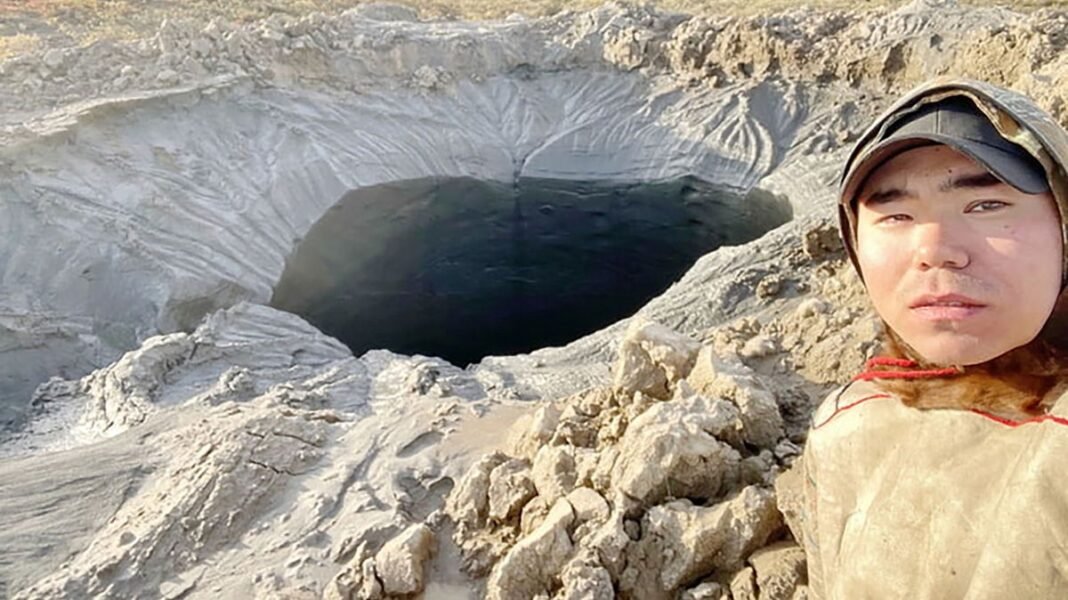

An enormous explosion has caused a significant crater to form near one of Vladimir Putin’s key gas supply locations. Recent images depict the aftermath of the sizable blast that destroyed a “gas-dynamic heaving mound” in the Russian Arctic. Witnesses observed a mushroom-shaped flame soaring high into the Arctic sky, sending frozen rocks across the tundra.
The explosion, which scattered debris over 330 feet from the center, occurred in August 2024, with details of the incident only recently emerging. The site is in close proximity to Gazprom’s major gas fields on the Yamal peninsula, posing additional risks amid Russia’s ongoing energy crisis.
Recent successful Ukrainian drone attacks have severely disrupted Russia’s oil supply, leading to long queues at gas stations and surging fuel prices. Indigenous reindeer herder Mayma Khudi recounted witnessing the explosion of the gas crater, noting the visible flame that could be seen from a remarkable 18 miles away.
Nine days later, Khudi visited the site and captured images of a freshly created, perfectly round hole in the tundra – adding to a series of mysterious Arctic craters in Russia. By mid-September, a scientific team accessed the remote location by helicopter, utilizing drones to survey the broad pit and collect water samples from the bottom.
A new study from the Russian Academy of Sciences has disclosed the rapid increase in pressure inside the mound and the potential implications for Russia’s expansive Arctic gas sector. Researchers found a crater throat approximately 21–22 feet wide beneath the ejected soil and ice ring, with a hidden cavity extending about 52 feet below the surface.
Furthermore, they observed an elongated elliptical floor, around 11 by 55 feet, aligned with a deep geological fault that channels gas upwards. Satellite data from the last 12 years revealed a significant growth in the mound’s height, averaging 16 inches annually between 2020 and 2024, before it ruptured – a rate surpassing that of typical permafrost mounds.
These pressurized gas domes, like the C23 crater, are part of a concerning trend. Over 20 giant craters have been identified in northern-western Siberia since 2014, with researchers identifying thousands of similar swollen ‘timebomb’ mounds in the Yamal peninsula alone. The explosion of nearby craters like C2 in 2012 and C22 in 2023 raise alarms, especially as C23 detonated in close proximity to key gas infrastructure.
The Bovanenkovo gas field, where C23 erupted, is one of the largest in the world. Researchers now suggest that these mounds form as gas accumulates under frozen ice caps, building pressure before erupting violently. Monitoring these mounds, which can rise around 16 inches annually, is crucial for identifying potential hazards and should be done using drones, satellites, and interferometric radar, as recommended by the experts.