
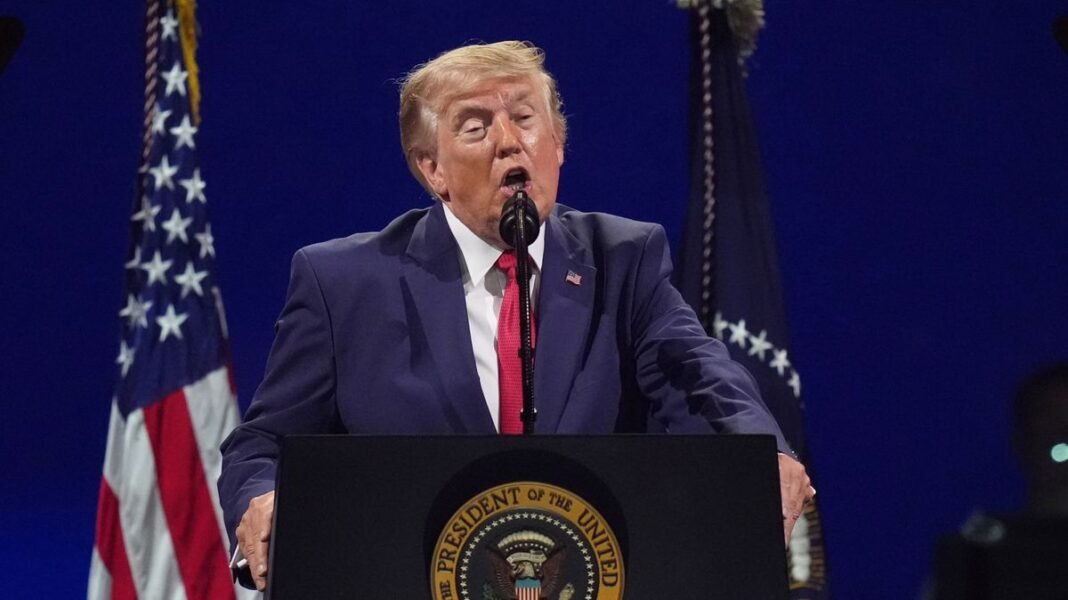

Donald Trump passionately spoke about communism and urged Congress to pass his election integrity bill during the commemoration of America’s 250th Anniversary.
The President later seemed to doze off during what he described as the most significant fireworks display ever, deviating from using the occasion to bring the nation together on the Fourth of July. In his 35-minute speech, Trump revisited familiar themes, labeling his adversaries as un-American Communists, touting his defense of gun rights, and highlighting his own achievements. He called on Republicans to approve the “SAVE America Act,” a legislation overhaul aiming to secure perpetual victories for his party. Additionally, he playfully mentioned the idea of serving a third term in office.
The event encountered disruptions, with Trump’s address delayed due to the evacuation of thousands of supporters from the venue amid thunderstorms.
Key points from Trump’s July 4th address shed light on his push for the SAVE America Act, a bill he claims will safeguard elections by enforcing strict photo ID requirements, centralizing voter registration processes, and restricting mail-in voting. However, the bill faces significant hurdles in the current political landscape, lacking necessary support to surpass a Democratic filibuster. Trump’s relentless assertions of election fraud could potentially cast doubt on the outcome of future elections, even if his bill fails to materialize.
“We aim to preserve America’s greatness by passing the SAVE America act, ensuring voters present valid ID to prevent election fraud,” Trump emphasized in his speech.
Trump’s rhetoric also targeted his political opponents, branding them as “communists” in a bid to undermine their legitimacy. This labeling tactic follows recent electoral successes by progressive Democratic candidates, exemplified by Mayor Zohran Mamdani in New York. Trump escalated his rhetoric by referring to these candidates as a “cancer” that needs to be eradicated, even suggesting exile during his Mount Rushmore speech.
Asserting America’s stance against communism, Trump emphatically rejected the ideology, emphasizing its incompatibility with American values. He likened communism to a cancer that must be swiftly eradicated to protect the nation’s ideals and principles.
Reflecting on his military actions, Trump hinted at serving beyond his second term, insinuating his victory in the 2020 election. However, it is important to note that he was defeated by Joe Biden in the actual election.
Trump also expressed grievances about his treatment within the legal system post-presidency, despite facing federal charges during his first term. While some serious allegations were dropped before his return to office, Trump continued to voice dissatisfaction with his perceived mistreatment.
Before delivering his speech, Trump hyped up the Independence Day fireworks display as the largest in history, promising a remarkable show with 850,000 pyrotechnic effects. However, the event faced delays and disruptions, including the evacuation of attendees due to impending lightning strikes, before eventually resuming.
Overall, Trump’s address on July 4th encompassed a mix of political messaging, patriotic fervor, and personal reflections amid a backdrop of celebratory events and logistical challenges.