
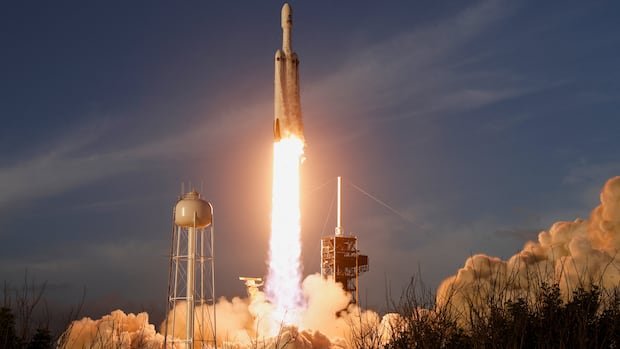

NASA embarked on a new venture to investigate significant unknowns in astrophysics and cosmology by launching the Nancy Grace Roman Space Telescope, the U.S. space agency’s latest flagship astronomical observatory. The telescope, repurposed from a spy satellite, aims to capture expansive views of the cosmos.
Costing around $4 billion, the Nancy Grace Roman Space Telescope was sent into space from NASA’s Kennedy Space Center in Cape Canaveral, Fla., aboard a SpaceX Falcon Heavy rocket under clear skies just after sunrise. The mission is scheduled for five years, but NASA mentioned the potential for an additional five years based on fuel availability.
Positioned in orbit beyond the moon, the telescope is designed to explore cosmic puzzles like dark energy and dark matter, study gravity on large scales, and search for exoplanets, which are planets outside our solar system.
The launch on Sunday signified a significant milestone for the engineers and a new beginning for the scientists, as stated by Julie McEnery, the senior project scientist for the Roman telescope, during a post-launch press briefing. She described the moment as standing on the edge of the unknown.
Originally intended for a spy satellite program managed by the National Reconnaissance Office, the telescope was repurposed by NASA for cosmic exploration after the spy satellite project faced budget overruns and was discontinued in 2012.
Named after NASA’s first chief astronomer, known as the “mother of the Hubble Space Telescope,” the Roman telescope will journey towards Lagrange Point 2, approximately 1.6 million kilometers from Earth. Over the next 90 days, mission scientists will commission the telescope and prepare for its scientific operations, with the first high-resolution images expected to be transmitted before the winter holidays, according to Roman telescope project manager Jackie Townsend.
NASA Administrator Jared Isaacman expressed confidence that the Roman telescope would become as renowned as other orbiting observatories such as the James Webb Space Telescope and the Hubble Space Telescope. McEnery highlighted that Roman, comparable in sensitivity and vision sharpness to Hubble, will survey the cosmos at a faster pace, able to cover the Milky Way galaxy in a month compared to Hubble’s century-long timeframe.
The Roman telescope’s primary objective is to unravel the mysteries surrounding dark energy and dark matter by creating an extensive 3D map of the universe, with its main survey expected to encompass over two billion galaxies. This mission is crucial in shedding light on the universe’s composition, which includes ordinary matter, dark matter, and dark energy, with dark energy believed to be the driving force behind the universe’s accelerating expansion.
In addition to its cosmic investigations, Roman will conduct an exhaustive search for exoplanets, anticipating the discovery of numerous new planets and providing a groundbreaking statistical analysis of planetary systems akin to our own.