
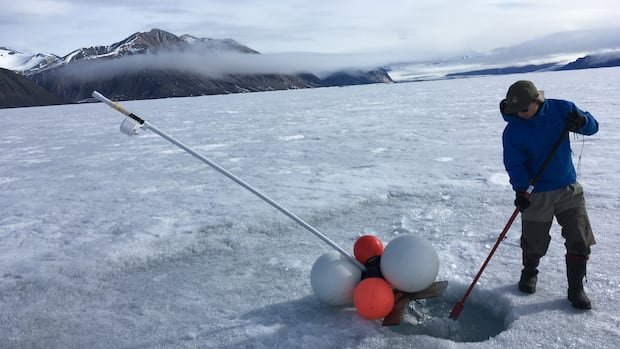

A unique freshwater lake in Canada, known as an epishelf lake, has recently vanished, leading to the loss of its distinctive ecosystem, according to a study by scientists. Jérémie Bonneau, the study’s lead author and an assistant professor at Laval University in Quebec City, expressed sorrow over the disappearance of the Milne Fiord epishelf lake on Ellesmere Island in Nunavut, emphasizing that it was the last of its kind in Canada. The abrupt disappearance of this once common natural phenomenon serves as a poignant example of the Arctic’s ongoing transformation due to climate change.
Although previous reports had indicated the demise of the lake, a recent study published in Scientific Reports provided detailed insights into the lake’s disappearance and highlighted that its irreversible loss signifies the end of a 4000-year era. The study revealed that the Milne Ice Shelf collapse in 2020 was the pivotal event that led to the lake’s disappearance. The ice shelf breaking into pieces released the freshwater accumulated on top of the saltwater, causing the lake to drain completely within a short period.
Epishelf lakes form when glaciers dam the flow of freshwater into the ocean, allowing it to accumulate on top of seawater due to density differences. The Milne Fiord epishelf lake, existing for over 4000 years, housed distinct freshwater and saltwater ecosystems within close proximity. The unique microbial communities thriving in these layers showcased minimal overlap, creating two separate ecosystems within the same water column.
Following the ice shelf collapse, the lake’s inhabitants faced a sudden demise as the freshwater mixed with the surrounding seawater. The loss of this rare epishelf lake in Canada underscores the broader impact of climate change on delicate ecosystems. While epishelf lakes are now extinct in Canada, a few still exist in Greenland and Antarctica. Scientists warn that these remarkable ecosystems are at risk, emphasizing the urgent need for environmental conservation efforts to preserve the planet’s natural beauty and biodiversity.