

Josh Wells, a university student from Iowa, was thrilled to visit Montreal for the first time outside the U.S. However, while browsing through Airbnb listings for accommodations, he started to notice discrepancies that raised his suspicions.
Many of the hosts had profile images that Wells believed might have been created by artificial intelligence.
“When a regular person takes a photo with an iPhone, there are usually some imperfections,” Wells explained to CBC’s Cost of Living. “The AI-generated images appeared far too flawless.”
Despite his concerns, he continued to explore the options available. He was on the verge of reserving one of the places when a closer inspection of the listing’s pictures raised yet another warning sign.
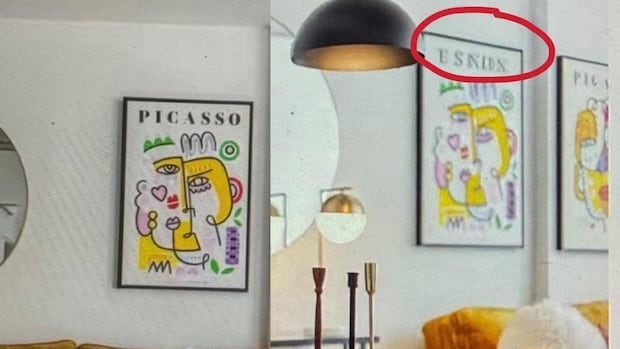
Upon zooming in on a wall art piece featuring two halves of faces combined, he noticed that the top read “Picasso.” However, a different angle of the same room showed the artwork appearing altered.
“The text looked all distorted and strange,” he remarked. “I thought, ‘Yep, this is definitely AI.'”

While planning his trip to Montreal, Wells encountered numerous Airbnb listings featuring overly polished photographs, prompting doubts about their authenticity. Strict regulations govern short-term rentals in the city, aimed at preserving the local housing market. (Josh Wells/Reddit)
This discovery was enough for Wells to abandon the listing and ultimately decide against using Airbnb for his trip. Unsure whether the images depicted a legitimate property or an AI-crafted version, he chose to book an apartment-style hotel instead.
“The fake profile picture was one issue, but the listings of the actual place where I would be spending thousands of dollars was an immediate dealbreaker,” Wells stated.
Wells is not alone in his skepticism regarding whether images on Airbnb or similar short-term rental platforms accurately represent real properties.
In July, an Ottawa family reported their daughter arriving at a Toronto Airbnb only to find the room looked drastically different from the photos, which they believed had been generated or significantly altered using AI.
The family presented side-by-side images highlighting the discrepancies in the room and bathroom. Although Airbnb acknowledged that the listing did not align with the actual property and refunded the guest, they did not confirm the involvement of artificial intelligence.
As AI technology simplifies photo alterations, experts warn that travelers may increasingly struggle to determine if Airbnb listings accurately depict reality, raising concerns about consumer trust and protections in Canada.
When a photo makeover goes too far
The rise of accessible, quick, and user-friendly AI tools is making photo editing more appealing, according to Francis Syms, associate dean at Humber Polytechnic’s faculty of applied sciences and technology in Toronto.
In addition to major AI platforms like ChatGPT, Claude by Anthropic, and Google’s Gemini, numerous other websites provide free tools for image modifications, Syms noted. For instance, Hugging Face features thousands of AI resources allowing users to upload and edit images.
“In just 10 seconds, you can upload a photo to one of these platforms and request it to eliminate smudges or alter the furniture,” he explained. “You’ll receive the edited image back in about 30 to 60 seconds.”

Platforms utilizing artificial intelligence, such as ChatGPT, enable users to swiftly and easily modify photos. (Marco Bertorello/AFP via Getty Images)
Determining when AI editing crosses into deception is challenging, according to Daniel Guttentag, an associate professor of hospitality and tourism management at the College of Charleston in South Carolina.
“If you add a fake hot tub to the back patio, I think everyone would agree that is a clear misrepresentation of what the unit offers,” he asserted. “However, if you merely tweak the lighting a bit… I believe most people would be fine with that.”
“Yet there’s a significant gray area in between, where it becomes, ‘Hold on, this isn’t what I signed up for.'”
Guttentag also raised concerns about the potential for AI-edited images to falsely suggest that guests have caused property damage, which could lead to compensation disputes.
In 2025, a guest from London, U.K., booked an Airbnb in Manhattan and was accused of causing damages exceeding £12,000 ($22,665).
She contested the claim after noticing discrepancies in photos of a supposedly damaged coffee table, which she suspected had been digitally altered or created using AI.
Initially, Airbnb claimed she was liable for over £5,000 ($9,444), but later fully refunded her after the situation garnered media coverage.
Can you trust what you see online?
For Airbnb guests, relying on listing photos to decide which property to book underscores the importance of trust, said Guttentag.
“You can’t try it on like a pair of shoes,” he noted. “You must have faith that it will meet your expectations.”
Although AI-enhanced images may assist hosts in securing bookings in the short run, guests who arrive to find significant discrepancies may leave unfavorable reviews, Guttentag warned. If consumers feel misled “one too many times,” it could lead to them abandoning the platform altogether.

Daniel Guttentag serves as an associate professor of hospitality and tourism management at the College of Charleston in South Carolina, focusing on research related to Airbnb and artificial intelligence. (Submitted by Daniel Guttentag)
In a response to CBC News, Airbnb stated that its policies require that listings be “accurately depicted” and that the company may request hosts to take down content that uses AI or other digital means to “edit flaws, conceal damage, add features or characteristics not present in a listing, or otherwise materially misrepresent the listing.”
Additionally, the company encourages guests to report misleading listings, and those who discover a property that does not align with its description can reach out to its 24/7 community support team. Under AirCover, Airbnb mentioned it may assist guests in finding a similar property or provide a refund if the host fails to address the issue.
In August, California implemented the Artificial Intelligence Transparency Act (CAITA), mandating that AI-generated images, videos, and audio carry information to help consumers identify whether digital content was created or altered with AI.
A figurine in front of the logo of the AI assistant “Claude” developed by the U.S. artificial intelligence safety and research organization Anthropic during a photo session in Paris on February 13, 2026. (Joel Saget/AFP via Getty Images)
Canada has not yet enacted any AI-specific laws addressing misleading advertising, according to Steve Szentesi, a competition and advertising lawyer based in Toronto. Nonetheless, he noted that existing regulations can already be applied to deceptive AI-generated imagery.
The federal Competition Act prohibits misleading advertising, regardless of whether the claims are made through text, images, audio, or other forms of media. Consumer protection laws at the provincial and territorial levels offer similar safeguards.
While AI-generated images are a relatively new phenomenon, Szentesi emphasized that the fundamental issue is not. Courts have addressed real estate listing disputes for decades, including cases where property photos did not match the actual home or contradicted the descriptions in the listings.
For consumers who feel a short-term rental listing misrepresents a property, Szentesi recommends first addressing the matter with the rental platform. They can also lodge a complaint with the Competition Bureau or their respective provincial or territorial consumer protection agency.
-
AI ‘slop’ is dominating menus, as some restaurant owners turn to it to save time and money
-
Can I get AI face? Plastic surgeons say AI-generated inspiration is more than meets the eye
Meanwhile, Syms advises potential renters to look for signs of AI-generated images in listing photos, such as misaligned door frames, uneven tile lines and countertops, unusually shaped furniture, inconsistent shadows or reflections, and unclear or distorted text on books or wall art.
Travelers may also utilize tools like Google Lens to search for the same image online, verifying whether it has been sourced from another site instead of showing the actual property.
For Wells, this experience has not completely deterred him from using Airbnb — he had a successful booking experience with the platform in Kansas City in March. However, his attempt to find a place in Montreal has made him more cautious, he shared.
“I remain open to using it again as long as there are no fake AI listings involved.”