
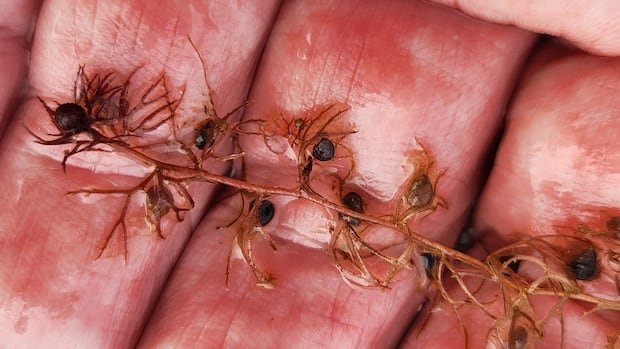

Plant enthusiast Klaus Koehler made a unique discovery in July while exploring the Sylvia Grinnell Territorial Park near Iqaluit. He stumbled upon a rare plant species not commonly found in the Arctic region, raising concerns about the potential impact of invasive species encroaching on Northern ecosystems as temperatures rise.
Koehler encountered a peculiar brownish aquatic plant known as bladderwort as he reached into a pond during his walk. Despite its unassuming appearance to the untrained eye, Koehler recognized the plant’s distinct features.
This carnivorous plant is adorned with small black bladder-like structures containing partially digested flies. Typically thriving in more temperate climates, bladderwort rarely ventures into Arctic territories, making Koehler’s discovery significant.
The only previous documented instance of bladderwort in the area dates back to 2012 when a team of researchers found samples near Kimmirut, approximately 120 kilometers southwest of Iqaluit. Their findings were documented in the scientific journal Phytokeys. During their expeditions to the Arctic, the team identified over 30 previously unknown plant species within the Arctic archipelago.
Koehler views the presence of bladderwort as a potential indicator of shifting climatic conditions. While the Arctic has traditionally hosted few invasive species due to its harsh environment, the warming climate is creating a more favorable habitat for non-native plants to establish themselves in the region.
He anticipates that prolonged warm summers and reduced winters will lead to alterations in the Arctic ecosystem, with an increase in both invasive and native plant species expanding their ranges northward.
Paul Sokoloff, a senior research assistant at Ottawa’s Museum of Nature and a member of the 2012 study team that discovered bladderwort, shares Koehler’s concerns. He highlights the various pathways through which plant seeds could be introduced to Arctic environments, including birds, cargo ships, and the footwear of visiting individuals.
Sokoloff emphasizes the need to prevent invasive species from outcompeting native flora, citing the detrimental impact of invasive grass like Phragmite in Ontario. While Koehler’s finding may not pose an immediate threat, Sokoloff warns that numerous plant species have the potential to disrupt Arctic ecosystems if left unchecked.
A study conducted by scientists from the Norwegian University of Science and Technology in 2025 identified over 2,500 plant species capable of invading Arctic regions, posing a threat to indigenous plant life.
Koehler intends to collect a sample of the bladderwort in Iqaluit for further analysis at the Museum of Nature, aiming to deepen scientific understanding of the plant’s northward expansion.