
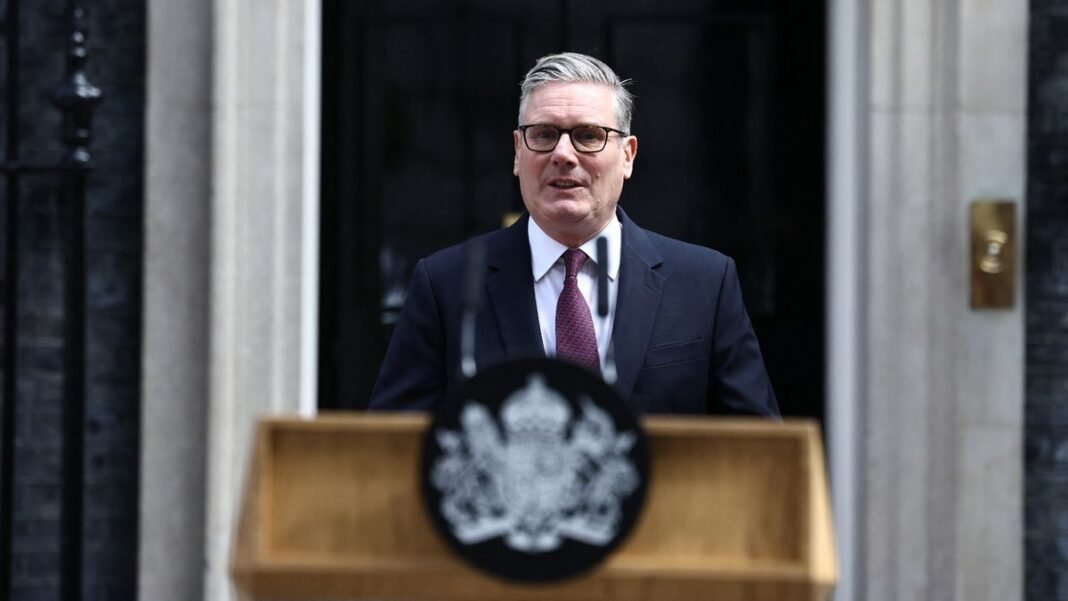

The British pound rebounded from earlier declines, and government borrowing costs eased amidst the fallout following Keir Starmer’s resignation. In the midst of political upheaval in Westminster, investors cautiously considered the potential of Andy Burnham stepping in as the new Prime Minister.
In morning trading, the pound rose by 0.05% to $1.324 after initially being down by 0.3% before Starmer’s departure announcement. It also saw a 0.07% increase against the euro to 1.154. The currency had already depreciated by approximately 3% since February as challenges to Sir Keir’s leadership within the Labour party mounted.
Following Starmer’s emotional speech, the yield on 10-year government gilts briefly rose to 4.85% but later dropped to 4.81% after former health secretary Wes Streeting endorsed Burnham as a potential successor. This endorsement reduced the likelihood of a prolonged leadership battle, and the 30-year gilt yield remained relatively stable.
Government gilts not only impact borrowing costs but also influence fixed-rate mortgage rates. When UK government bond yields increase, banks face higher wholesale funding and hedging expenses. This was evident after a failed budget event in September 2022, where gilt yields spiked, leading to a surge in mortgage rates. However, average two and five-year mortgage rates have significantly decreased since then.
Adam French, head of consumer finance at Moneyfactscompare.co.uk, noted that financial markets had already factored in political uncertainty prior to Starmer’s resignation. He highlighted the importance of future PM Burnham’s fiscal policies on taxation and public spending in shaping market dynamics.
The reaction on the stock market was subdued, with the FTSE 100 experiencing only marginal declines. Market participants had already anticipated Starmer’s potential resignation given recent events.
As Starmer outlined his departure timeline, paving the way for Burnham to potentially become the seventh UK leader post-Brexit, attention shifted to the bond market due to the country’s high borrowing costs and substantial national debt.
Chris Beauchamp, chief market analyst at IG, underscored the need for significant changes under Burnham’s leadership to address economic challenges. Analysts pointed out the ongoing political turbulence and economic constraints faced by UK leaders in recent years.
Despite the political developments, the stock market remained relatively stable, with the FTSE 100 showing positive year-on-year performance. Sterling experienced minor fluctuations against major currencies, reflecting market uncertainties.
Economists highlighted the importance of Burnham’s fiscal policies and choice of Chancellor in shaping the UK’s economic trajectory. The future approach to fiscal rules will be a key factor for market observers.