
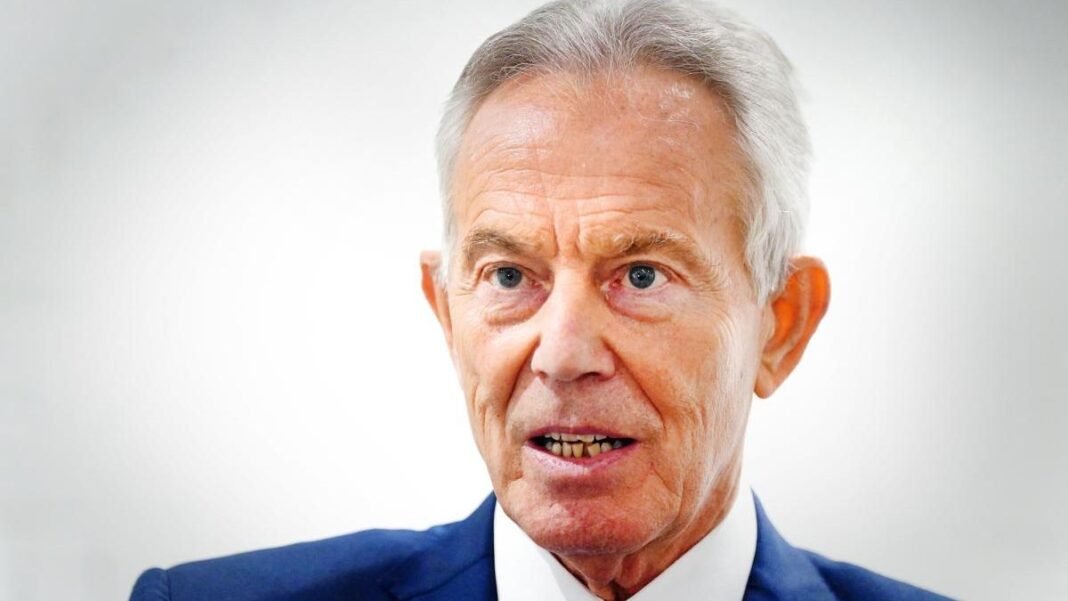

Tony Blair continues to present himself as the sole custodian of Labour’s essence. Periodically resurfacing, Blair cautions the party against veering too far left, growing skeptical of business, or losing touch with the essence of “modern Britain.” However, his recent 5,700-word essay diverges from his usual tone. Rather than offering advice as a former Labour leader, it reads as a proclamation that many of the party’s foundational principles are now seen as hurdles in Blair’s perspective.
Throughout the essay, Blair repeatedly portrays core Labour values as weaknesses. Worker protections are depicted as hindrances to economic growth, welfare is primarily discussed as a financial burden, and environmental aspirations are viewed as barriers to competitiveness. Public services are portrayed as entities in need of “transformation” through private-sector strategies and technological disruptions.
Interestingly, the essay lacks substantial discussion on topics such as inequality, precarious employment, struggling households, the cost of living, or the concentration of wealth and power. Instead, the narrative is filled with terms like “competitiveness,” “AI revolution,” “markets,” “deregulation,” and “growth.” It deviates from traditional Labour politics, resembling more a corporate consultancy pitch tailored for Silicon Valley elites.
Blair suggests that Labour should reconsider workers’ protections, push for deeper welfare cuts, scale back aspects of net zero initiatives, and embrace enhanced private-sector involvement in healthcare. His underlying message is clear: in Blair’s view, Labour’s primary role is to prioritize appeasing wealth and power, trusting that ordinary citizens will eventually benefit.
Of particular note is Blair’s current political affiliations. He openly praises the effectiveness of Donald Trump and cautions against Britain being overly wary of Trump’s America. This is the same U.S. leader known for divisive politics, attacks on democratic institutions, and disdain for labor protections, environmental regulations, and political adversaries.
Blair appears increasingly intrigued by Trump-style disruptive politics, advocating for the notion that dismantling conventions and institutions signifies strength. This inclination becomes more concerning when considering Blair’s current associations. His institute has received support linked to Larry Ellison, the billionaire founder of Oracle and a prominent Trump supporter. Blair also participates in Trump’s Board of Peace, a controversial project entwined with powerful billionaire and political interests globally.
Many Labour supporters view these associations with apprehension. Blair seems to be transitioning from a former Labour prime minister to an ambassador for billionaire technocracy, prioritizing innovation, disruption, and elite global networking over democracy, public services, and working-class priorities.
While it is crucial for Labour to embrace technology, growth, and modernization, its core purpose is not solely to enhance market efficiency or reassure billionaires of Britain’s investment appeal. The party exists to redistribute power, wealth, and opportunities among ordinary citizens.
Blair’s argument is flawed in its focus on efficiency and delivery while neglecting solidarity, community, and economic justice. Rather than leveraging Labour’s values as strengths to build upon, Blair views them as limitations to overcome.
Britain has endured decades of politics shaped by deregulation, globalization, and corporate elitism, leading to increased public discontent and distrust. Labour excels when it unreservedly champions the interests of working people. Straying towards a consultancy-oriented presentation aimed at tech magnates and Trump’s associates risks diluting the very essence of Labour that Blair claims to comprehend.