
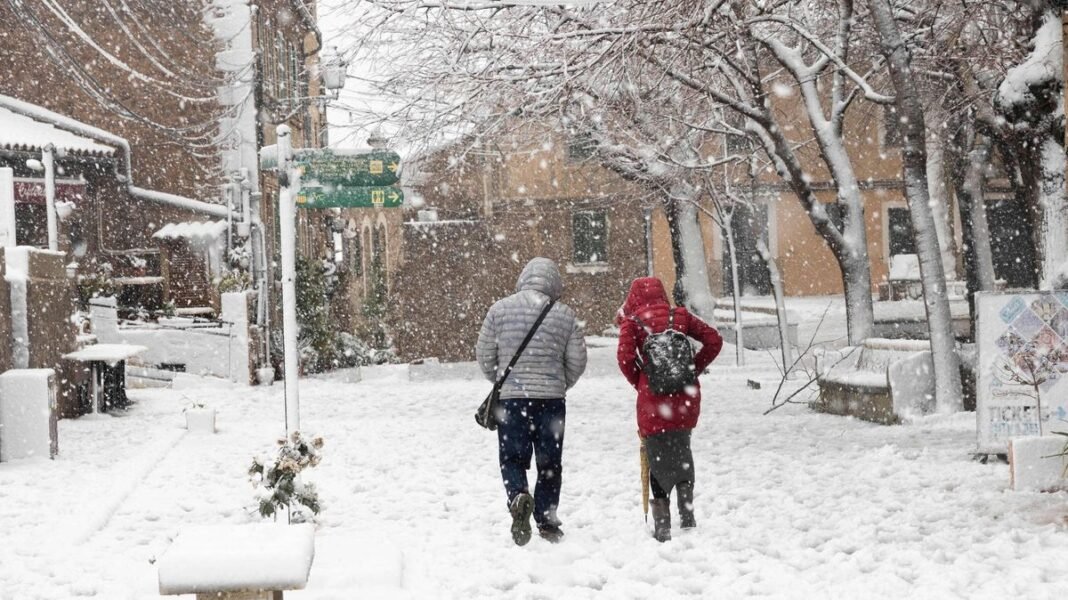

Brits currently in Spain are bracing for severe wintry weather conditions this week as an unusual Arctic blast sweeps across the country, expected to bring up to 25cm of snow to northern regions. Multiple weather alerts have been issued in various areas, including popular tourist destinations, warning of potential disruptions for travelers and locals.
The heaviest snowfall is predicted in regions near Santander, Bilbao, and the Cantabrian Mountains, with up to 25cm of snowfall anticipated within a 24-hour period. Higher elevations, starting from around 900 meters, are already experiencing snow accumulation, and the freezing level is expected to drop to 700 meters by the end of the day, particularly in the northern areas.
Mountainous areas inland from Santander are on high alert for approximately 20cm of snow, while locations in and around Navarre and northern La Rioja could see up to 10cm. Even regions like the inland area near San Sebastián, usually milder, are forecasted to receive around 5cm of snow as cold air spreads further along the northern coast.
The wintry conditions are not limited to the north. Snowfall has been reported in southern areas, including the Burgos Plateau, the La Rioja wine region, inland Zaragoza province, and elevated parts of the Castellón region north of Valencia. In addition to the snow risk, forecasters have issued warnings for rain, wind, and storms in Mallorca, where strong gusts and heavy showers are expected throughout the day. Most weather alerts are in effect until 6 pm.
According to the latest updates from the Met Office, major Spanish cities are experiencing cold temperatures, with Zaragoza and Madrid barely reaching 5°C, while Bilbao is at 7°C with rain. Coastal cities like Valencia, Seville, and Málaga are slightly warmer at around 10–11°C with sunny intervals, whereas Barcelona is expected to have a cool 8°C.
Spain attracts approximately 18 million British visitors yearly, making it the preferred holiday destination for UK citizens. Recently, British travelers were advised to prepare for severe weather conditions and potential travel disruptions in Murcia, southeastern Spain, and Valencia on the eastern Mediterranean coast.
This weather pattern follows a significant drop in temperatures in the UK, with overnight lows reaching as low as minus 11°C. The coldest temperature was recorded at Loch Glascarnoch in the Scottish Highlands, with temperatures dropping below minus 7°C across most of the country. In contrast, England and Wales experienced slightly milder temperatures, with lows of minus 6°C in Trawsgoed, Wales, and minus 4°C in Rostherne, Cheshire.
Meteorologist Simon Partridge attributed the chill to “a little ridge of high pressure moving across the UK overnight,” noting that the lighter winds were the main distinguishing factor from previous nights.