
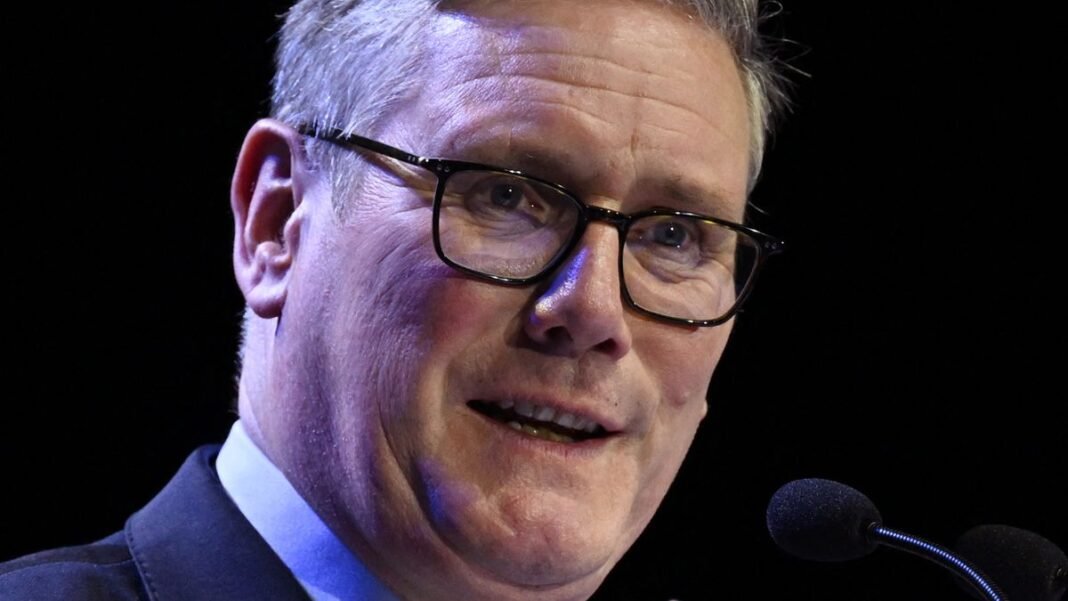

A recent warning to Keir Starmer indicates that despite a significant drop, the continuous emphasis on migration issues has led most voters to believe that migration rates are on the rise. New data to be released today is expected to show that net migration has decreased to pre-Brexit levels. However, public perception remains skewed, with a majority perceiving an increase in migration numbers, raising concerns that the government’s messaging may be reinforcing the idea that immigration is unmanageable.
According to a survey by Ipsos/British Future Immigration Attitudes Tracker, 56% of the public wrongly believes that net migration increased last year. In reality, the figures for 2024 show a significant decrease, more than halving from 848,000 to 345,000, after peaking in 2023 at 944,000.
Sunder Katwala, director of the British Future thinktank, pointed out that although net migration is declining and nearing pre-Brexit levels of around 300,000, the political discourse has not adjusted accordingly. The continuous focus on reducing numbers may not be sustainable as public perceptions of immigration being “out of control” persist, leading to a polarization of attitudes.
The study also revealed a misconception among the public regarding the proportion of asylum seekers in overall immigration, with many overestimating it. While most individuals hold balanced views on immigration, there is a growing segment that believes immigration brings no benefits, signaling a shift in public opinion.
A call for a more transparent debate on immigration policies and their impacts has been made by experts. Gideon Skinner, senior director of UK Politics at Ipsos, highlighted the increasing prominence of immigration in public discourse and the need for a nuanced approach to address concerns effectively. The report recommends scaling up the UK–France asylum deal to manage Channel crossings and emphasizes the importance of distinguishing legitimate concerns from prejudice in the immigration debate.