
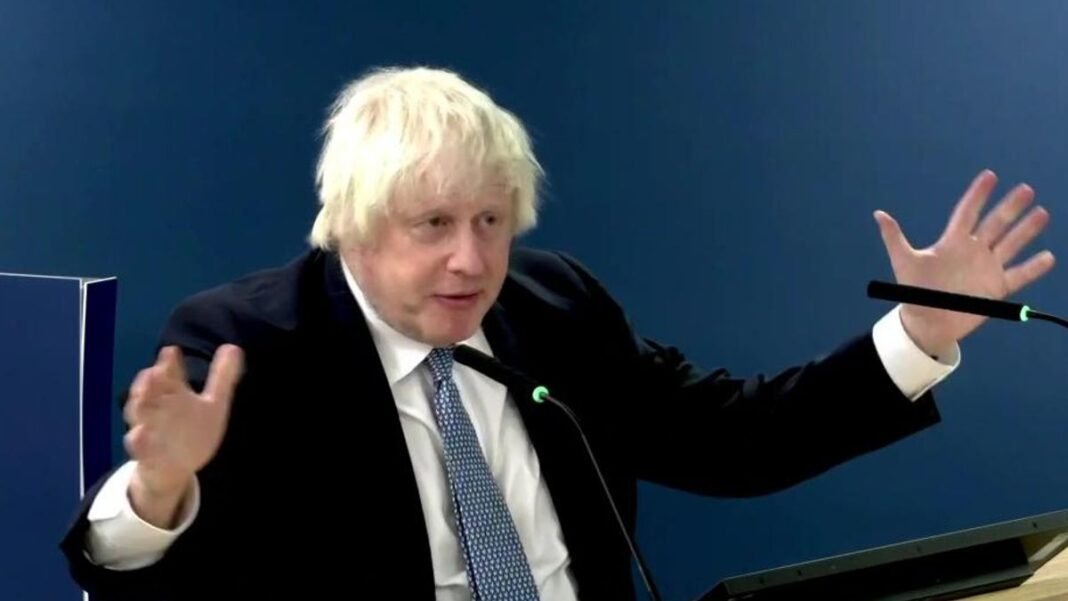

Boris Johnson has been criticized for fostering a disorderly environment within his government during the peak of the Covid pandemic, where the most vocal individuals held sway, hampering effective decision-making, as revealed by an inquiry.
The Covid Inquiry’s scathing assessment of the government’s pandemic management highlighted Boris Johnson’s failure to provide clear and timely directives, leading to avoidable fatalities and necessitated lockdowns that could have been averted. The report underscored that the former PM cultivated a toxic atmosphere at the heart of his administration, empowering the “loudest voices” to dominate decision-making processes.
Baroness Hallett, heading the inquiry, pinpointed that Mr. Johnson perpetuated a culture that allowed disruptive figures like Dominic Cummings, a key advisor, to obstruct the decision-making process.
According to Baroness Hallett, Mr. Johnson’s tolerance, and at times endorsement, of this chaotic culture perpetuated a climate where dissenting opinions, especially from female colleagues, were disregarded, to the detriment of sound decision-making.
One notable consequence of the government’s tumultuous core was the implementation of the £840 million Eat Out to Help Out initiative, initiated without proper consultation with the Scientific Advisory Group for Emergencies (SAGE), the government’s scientific advisors. Despite aiming to boost the economy during a critical period in August 2020, SAGE advisors contended that the scheme, by offering discounts for dining out, escalated infection rates, in contradiction to public health messages stressing social distancing and cautious indoor socializing.
The inquiry highlighted that the scheme was devised without scientific input, contradicting established public health guidelines. Speaking about the scheme, Chief Medical Officer Chris Whitty labeled it as “eat out to help out the virus.” While Boris Johnson initially claimed thorough discussions with scientific advisors, it was later confirmed that no advisors were present during meetings with Chancellor Rishi Sunak regarding the scheme.
Although the Eat Out to Help Out scheme provided a much-needed boost to the hospitality sector, it coincided with a substantial surge in Covid cases. Case numbers in the UK surged from approximately 6,400 in the first week of August to a significantly higher 23,000 in the following week, marking a notable 250 percent increase.