
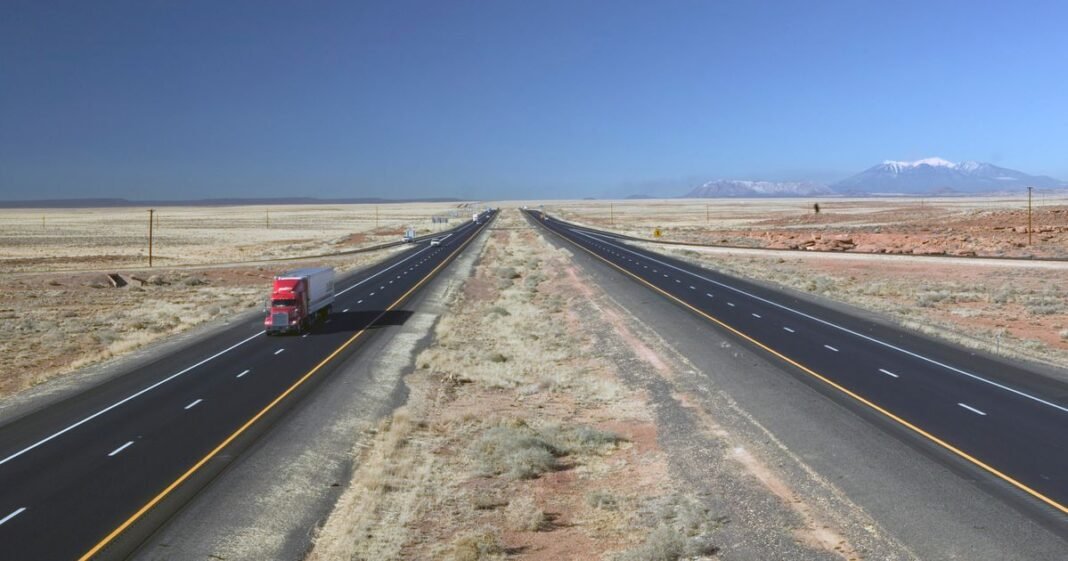

A man has shared unsettling revelations about the hidden mysteries surrounding a well-known road that has been linked to a series of unsolved murders over the years. Through a TikTok video captured while driving along Interstate 40, he brought attention back to a perplexing issue that the FBI has been investigating for nearly two decades – a pattern of bodies discovered off major US highways, commonly in remote areas and truck stops, dating back to the 1980s.
The FBI’s records indicate numerous victims whose killings are thought to be connected to mobile criminals utilizing highways to prey on individuals before vanishing across state boundaries. The bureau confirms that the count of potential suspects flagged for scrutiny also reaches the hundreds, with figures constantly changing as fresh cases emerge.
The situation gained prominence in 2004 when Oklahoma analysts noticed a troubling cluster of murdered women along the I-40 corridor, prompting federal agents to take action. This discovery led to the expansion of the FBI’s Highway Serial Killings Initiative, a nationwide project aimed at identifying correlations between homicides occurring in proximity to major roadways.
Originating from the FBI’s Violent Criminal Apprehension Program (ViCAP) established in 1985 to compare violent crimes nationwide and detect patterns that local law enforcement might miss, the initiative revealed a disturbing trend of victims, often vulnerable women, being left in similar locations across multiple states, notably along interstate highways frequented by long-distance travelers.
Based on official data and FBI-led briefings, hundreds of homicide victims have been documented in the national highway-killings database. Some reports even suggest that the broader pool of highway-related killings over the past four decades could surpass 850 cases, with many remaining unsolved.
Authorities stress that this figure represents cases requiring further investigation, not a confirmed count of serial killers. The bureau has identified hundreds of potential suspects through submissions from law enforcement agencies nationwide, although many are classified as “persons of interest” rather than proven offenders.
Despite the grim statistics, the program has achieved notable successes. ViCAP has successfully linked seemingly isolated cases, connecting numerous murders to single perpetrators whose patterns of travel and crime only became evident when mapped against interstate routes. This matching of travel patterns with dump sites located miles apart prompted local authorities to revisit old cases, leading to the identification of long-missing victims.
Criminals’ ability to cross state lines, deposit a victim in an unfamiliar jurisdiction, and scatter evidence that takes years to piece together underscores the challenges of these investigations. Many victims had no strong ties to the areas where they were discovered, complicating identification efforts. Some victims were not reported missing at the time, making it difficult to establish timelines accurately.
For travelers venturing along I-40, a transcontinental road spanning from North Carolina to California, the road’s eerie reputation is widely acknowledged. In a TikTok video shared by user @nomadsanimalencounter, the driver highlighted the desolate stretches where numerous bodies have historically been found, noting the transient nature of the area with hotels and gas stations frequented by travelers but lacking permanent residents.
While I-40 has been a focal point for high-profile clusters, the issue extends across multiple highways throughout the United States.