
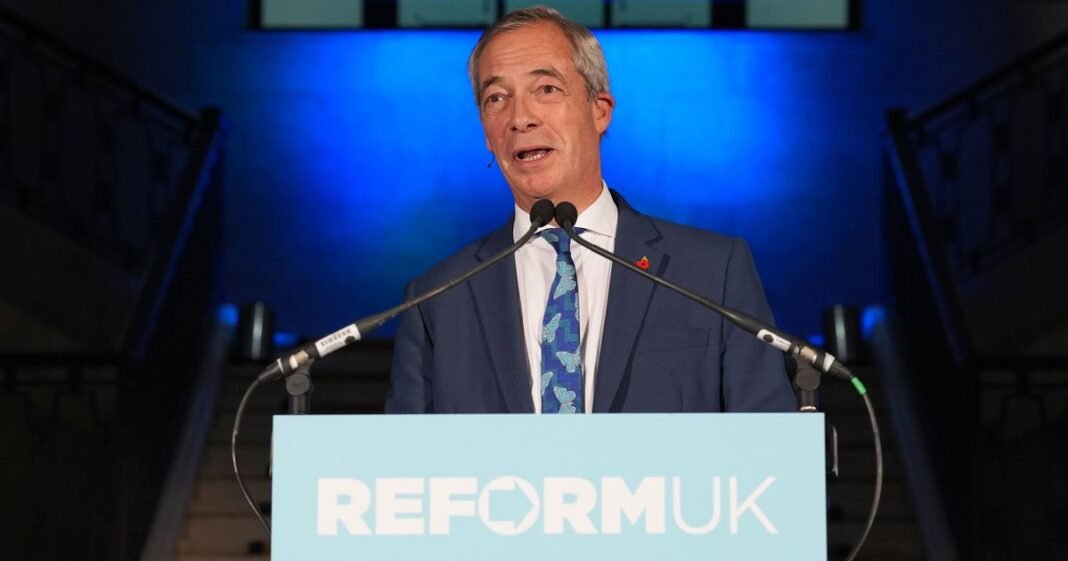

Nigel Farage has been accused of planning to make deeper cuts to public services than the Conservative Party, risking the welfare of pensioners, according to critics who labeled Reform as “vultures.”
During a speech in the City of London, the leader of Reform UK backtracked on tax promises worth billions but pledged to implement welfare reductions and significant decreases in public spending if his party gains power. Farage expressed concerns over economic instability potentially leading to a general election in 2027, lamenting missed opportunities post-Brexit.
Farage refrained from guaranteeing the preservation of the pensions triple lock and proposed lowering the minimum wage for young employees. He reiterated his controversial idea of assisting affluent foreign business moguls in tax avoidance.
Critics accused him of presenting a contradictory budget plan that would favor hedge funds and financial traders over ordinary workers. Farage’s uncertain stance on future economic conditions raised doubts on his proposed policies.
In response, Lib Dem deputy leader Daisy Cooper criticized Farage for targeting vulnerable pensioners to support his anti-net zero agenda and secretive advisory team, labeling Reform as “vultures” and vowing to defend pensioners.
Farage admitted that achieving substantial tax cuts might be more challenging than previously claimed, acknowledging the current economic constraints. He reiterated his proposal for a Britannia Card, enabling wealthy foreigners to avoid taxes on overseas earnings and inheritance.
Furthermore, he hinted at the possibility of reducing the minimum wage for younger workers, citing a misalignment with the lowered National Insurance Contributions threshold. Farage emphasized the need for decisive action by the government in addressing economic challenges.
Reform’s previous manifesto outlined tax reduction plans equivalent to one-third of the NHS budget, which experts criticized for being unrealistic and costly. TUC general secretary Paul Nowak criticized Reform as proponents of austerity, warning of severe consequences on public services and job sectors under Farage’s leadership.
Labour representatives condemned Farage’s austerity agenda, highlighting potential detrimental impacts on public services, job security, and infrastructure investments. Farage accused the government of hindering business growth and advocated for trickle-down economics to retain high-earning taxpayers.
Farage predicted a forthcoming general election amid economic turmoil and hinted at a return to austerity measures. Shadow Chancellor Sir Mel Stride criticized Reform’s economic proposals as lacking clarity and potentially causing chaos in the economy.