
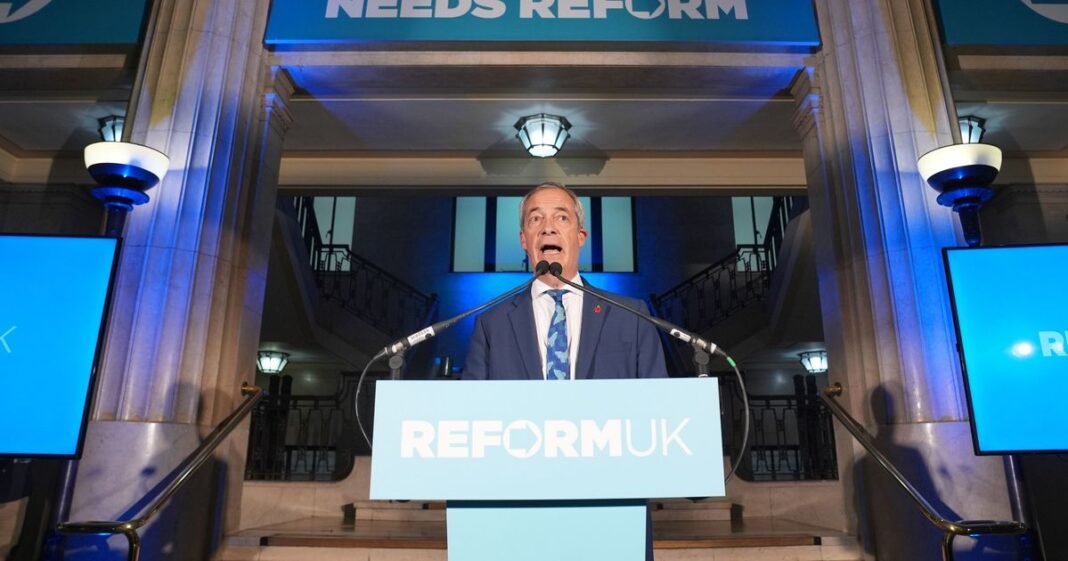

Nigel Farage predicts a financial crisis will lead to a general election in 2027. The Reform leader, vying to demonstrate his capability to manage the country’s finances, admitted that pledging extensive tax reductions is not practical. Nonetheless, he remains steadfast in his proposal to introduce a “golden opportunity for billionaires” should he assume the role of Prime Minister.
Criticism from the Institute for Fiscal Studies regarding Reform’s manifesto assertions, citing inadequate financial calculations, had been previously dismissed. Farage is anticipated to defend the decision to exit the EU, countering accusations from Rachel Reeves attributing the state of the British economy to Brexit.
Farage declined to disclose his potential choice for Chancellor. While denying Reform is a one-person operation, he acknowledged the party is not yet prepared to reveal key role appointees. Emphasizing that significant tax cuts are unfeasible given the prevailing debt situation, Farage outlined plans to alleviate tax burdens gradually, including eliminating inheritance tax on family-run businesses and increasing tax thresholds to alleviate financial strain on working individuals.
Addressing misconceptions about Reform’s welfare stance following Tory criticisms, Farage clarified the intention to support lower-income working couples by removing restrictions on child benefits. He defended the controversial proposal to grant foreign billionaires a “non-dom” tax status in exchange for a substantial fee, asserting that retaining high-earning individuals in the UK benefits the broader tax framework and economy.
Acknowledging the significance of the financial services sector as a cornerstone of the UK economy, Farage highlighted the need to reduce business regulations and lamented the constraints imposed by HR and compliance procedures hindering progress. Expressing regret over the perceived squandering of Brexit benefits, he criticized current regulations as more stringent than pre-Brexit levels.
Foreseeing economic turmoil triggering a general election in 2027, Farage pointed to a potential austerity budget and growing pessimism among businesses and savers. He attributed decreased prosperity among Britons to mass migration and expressed discontent with remote work practices.
In response to Reform UK’s economic strategy, Labour criticized Farage for advocating austerity measures and questioned the feasibility of his proposals based on the party’s performance in running councils. Farage is expected to advocate for reduced business regulations post-Brexit as a means to enhance competitiveness and economic growth.
Reeves, as Chancellor, introduced reforms aimed at simplifying regulations and supporting British businesses, while attributing economic challenges to Brexit. Keir Starmer and the PM have also emphasized deregulation as a means to stimulate investment and economic growth.
During the previous election campaign, Reform UK outlined ambitious tax reform proposals, including substantial tax breaks and reductions in inheritance tax and fuel duty. However, economists raised concerns about the feasibility of these plans, highlighting potential revenue shortfalls and economic risks. Farage is anticipated to retract the proposed £90 billion tax cuts in an upcoming speech following widespread criticism.