
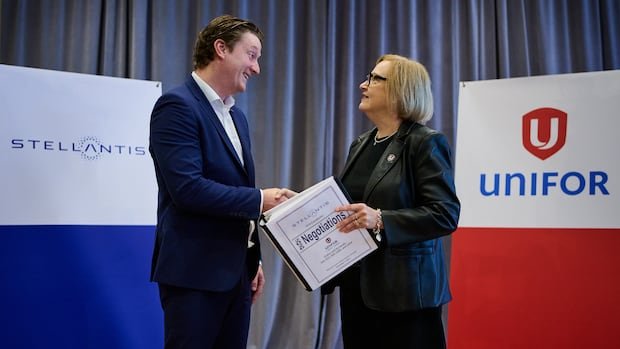

The labor union representing employees at Stellantis has cautioned the American automaker against undervaluing Canadian workers as contract discussions with Unifor commenced on Tuesday. This negotiation phase signifies the final segment of Unifor’s talks with the Detroit Three automakers, following a pattern bargaining strategy to establish terms for future agreements. Despite recently endorsing new collective deals with Ford Motor Co. and General Motors in Canada, Unifor’s national president Lana Payne emphasized that the upcoming negotiations pose significant challenges, particularly regarding job security after over 2,000 workers were laid off from Stellantis’ Brampton, Ontario, assembly plant.
Last month, the union received informal notice of Stellantis’ contemplation on closing and selling the plant, which was initially intended for Jeep production. The company shifted the production of the Jeep Compass to the U.S., leading to the plant’s indefinite closure, an action deemed a breach of the existing collective agreement by the union. Payne reiterated the union’s stance that the Jeep Compass production should have remained at the Brampton plant, emphasizing the need for Stellantis to rectify its relationship with employees and Canadians by reinstating work at the facility.
Stellantis acknowledged the significance of the labor discussions with the union for its future, highlighting the industry’s evolving trade and regulatory landscape as a key challenge. The company’s chairman and CEO emphasized Stellantis’ substantial investments in Canadian operations, underscoring the importance of the Canadian market and expressing confidence in reaching a mutually beneficial agreement during negotiations.
The ongoing talks are taking place against a backdrop of U.S. tariffs impacting local automakers, with potential tariff increases threatening the North American auto industry. Unifor is actively advocating to safeguard Canada’s auto sector and uphold the pattern agreement while also urging the government to resist trade agreements that could jeopardize the industry.
Larry Savage, a labor studies professor, emphasized that the current negotiations encompass broader efforts to preserve the Canadian auto industry, underscoring the union’s dual battles for industry sustainability. Unifor recently announced successful ratification of new contracts with General Motors, reflecting wage increases and mirroring agreements reached with Ford as part of the pattern bargaining strategy.