
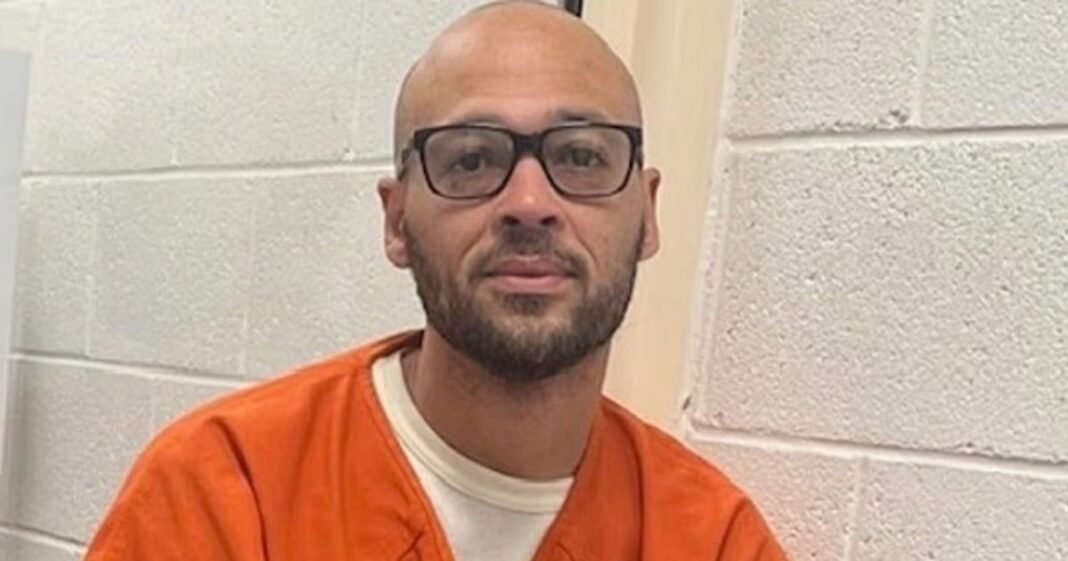

A prisoner on death row, whose life was spared just moments before his scheduled execution, was quickly taken for medical care after being found unresponsive in his cell by guards.
Tremane Wood, aged 46, had recently been informed by Oklahoma Governor Kevin Stitt of the last-minute decision to commute his death sentence to life imprisonment without parole. However, concern arose at the Oklahoma State Penitentiary when staff discovered Wood had collapsed in his cell during a routine check.
According to Department of Corrections spokeswoman Kay Thompson, Wood had seemed stable during a meeting with his legal team post the commutation, but later suffered a medical emergency attributed to dehydration and stress. Officials stated that he was in a “stable and alert” condition by Thursday evening.
In a recorded statement released after being taken to the hospital, Wood recounted losing consciousness while alone in his cell, mentioning waking up in the infirmary with injuries to his head and lip.
Wood emphasized that he had not self-harmed and disclosed that he had not eaten since the previous day. The recording concluded with Wood conveying his gratitude to Governor Stitt.
Wood, who was waiting in a holding cell adjacent to the death chamber, was informed of the governor’s decision to spare him. The move came after the victim’s family, hailing from a Hutterite community in Montana, supported clemency.
Convicted of fatally stabbing 19-year-old Ronnie Wipf during a failed robbery in 2002, Wood consistently asserted that his brother, who subsequently died while serving a life sentence, was the actual perpetrator. This marks only the second instance in nearly seven years where the Republican governor has granted clemency.
Governor Stitt justified the decision by stating that it mirrored the punishment meted out to Wood’s brother for the murder and ensured a strict penalty keeping a violent offender off the streets permanently.
The order also stipulated that Wood would never be eligible for commutation, parole, or pardon, similar to the conditions imposed on Julius Jones following his clemency in 2021.
Wood’s attorney, Amanda Bass Castro Alves, expressed profound gratitude, highlighting that the decision respected the wishes of Mr. Wipf’s family and the surviving victim, aiming to provide them with some solace.
Several Republican legislators advocated for clemency, culminating in a narrow 3-2 vote by the state’s Pardon and Parole Board in favor of mercy. However, one of the original prosecutors, George Burnett, raised concerns about the board’s influence over a case spanning two decades, maintaining evidence pointed to Wood as the killer.
Prosecutors portrayed Wood as a violent gang member engaging in criminal activities behind bars, including drug transactions, contraband phones, and ordering assaults. In a video testimony from prison, Wood admitted to misconduct but denied the murder, asserting his innocence.
On the same day, another grim execution took place in South Carolina, where mass murderer Stephen Bryant, 44, was executed by firing squad. Bryant, who committed a series of killings in 2004, attributed his actions to brain damage caused by prenatal exposure to alcohol and drugs. However, the South Carolina Supreme Court upheld his sentence, making him the third person in the state to be executed by firing squad this year.